


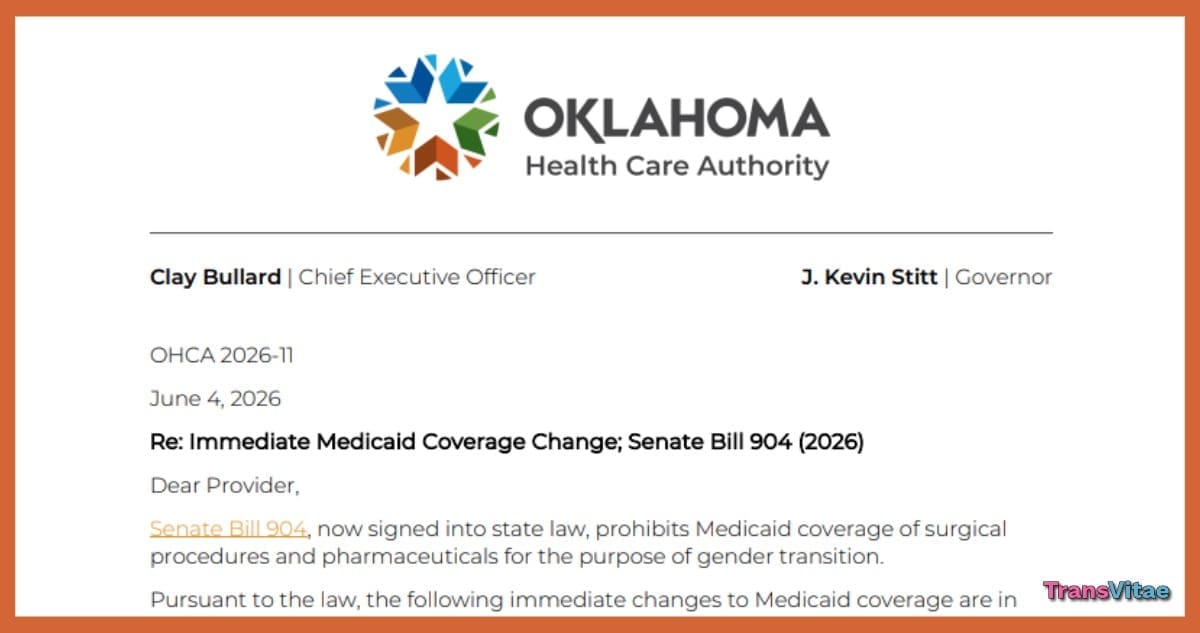
A new Oklahoma law is set to dramatically reshape access to gender-affirming healthcare for transgender residents who rely on Medicaid. The Oklahoma Health Care Authority (OHCA) has notified providers that Senate Bill 904, signed into law earlier this year, prohibits the state’s Medicaid program from covering gender transition procedures, including both surgical treatments and related pharmaceuticals.
According to the provider letter distributed by OHCA, the changes take effect July 1, 2026, and require healthcare providers to immediately adjust billing and treatment practices for SoonerCare patients. The agency stated that Medicaid will no longer reimburse for surgical procedures or medications prescribed for the purpose of gender transition.
The provider notice is the latest step in implementing Senate Bill 904, a controversial measure approved by the Oklahoma Legislature and signed by Governor Kevin Stitt in May. The law prohibits the use of public funds for gender transition procedures and specifically bars Oklahoma’s Medicaid program from providing coverage for such care, regardless of whether the patient is a minor or an adult.
While Oklahoma previously focused many of its transgender healthcare restrictions on minors, SB 904 extends those limitations to adults who depend on state-funded healthcare programs. Supporters of the legislation argued that taxpayer funds should not be used for gender transition-related treatments. Opponents contend that the law targets medically necessary healthcare and will disproportionately harm low-income transgender Oklahomans.
The provider letter outlines several procedure and prescription codes that will become non-covered services when used for gender transition purposes. Providers are instructed to identify affected patients and ensure claims submitted after the July implementation date comply with the new requirements.
The impact could be significant for transgender adults receiving hormone replacement therapy through SoonerCare. For many patients, Medicaid coverage has been the only affordable pathway to accessing medically supervised hormone treatment. The loss of coverage may force some individuals to pay out of pocket, seek assistance from community organizations, or go without care entirely.
National medical organizations, including the American Medical Association and the American Academy of Pediatrics, have consistently recognized gender-affirming care as evidence-based treatment when clinically appropriate. Critics of laws like SB 904 argue that restricting coverage creates barriers to healthcare while doing little to address broader healthcare access challenges facing states like Oklahoma.
Oklahoma joins a growing number of states that have enacted restrictions on public funding for gender-affirming healthcare. The state’s new policy arrives amid an ongoing national debate over transgender rights, healthcare access, and the role government should play in determining what treatments public insurance programs may cover. As the July 1 implementation date approaches, transgender Oklahomans who rely on SoonerCare are now facing difficult decisions about how they will continue accessing essential healthcare in the months ahead.
