


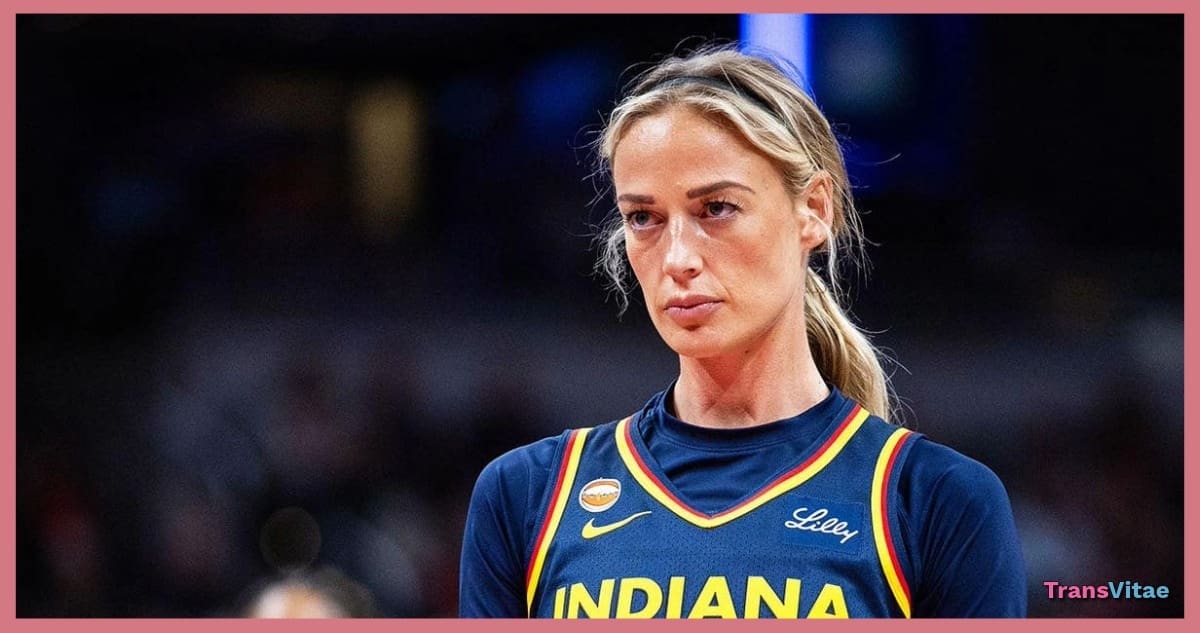
Indiana Fever guard Sophie Cunningham has once again found herself at the center of controversy after publicly speaking out against transgender women competing in women’s sports. Her latest remarks go further than comments she made four years ago, reflecting a broader shift from discussing competitive fairness to endorsing arguments commonly used to justify excluding transgender women from women’s athletics and gendered spaces.
Speaking in a recent ESPN profile, Cunningham rejected accusations that she is anti-trans, saying, “I got a lot of negative feedback about me hating trans. And I’m like, ‘I never once said that.'” She added that she wanted to “extend love,” but argued, “I want to protect young girls in a locker room, or young girls in sport who shouldn’t have to go against biological men.”
Those comments immediately drew criticism from LGBTQ+ advocates, who argue that framing transgender women as threats to girls’ safety reinforces harmful stereotypes that have been used to justify legislation restricting transgender rights across the country.
Cunningham’s comments also represent an evolution from her public stance during the 2022 controversy surrounding transgender swimmer Lia Thomas. At the time, Cunningham shared a social media post criticizing the NCAA’s policies before later clarifying her position.
“To my teammates, friends, family, supporters and fans, you know that I stand with all people, especially my fellow athletes,” she wrote. “I do not judge, but support all races, religions, sexual preferences and gender equity. We all have a place in this world to compete and I hope we are able to grant everyone that opportunity fairly.”
While her 2022 statement emphasized inclusion alongside fairness, her latest remarks explicitly describe transgender women as “biological men” and extend beyond athletic competition to locker room access, language that closely mirrors talking points promoted by conservative lawmakers advancing anti-trans legislation.
That broader political context is difficult to ignore. Over the past several years, transgender athletes have become one of the most visible targets in the culture war despite representing only a tiny fraction of competitors. Hundreds of bills have been introduced nationwide restricting transgender participation in sports, with many expanding into healthcare, education, identity documents, and public accommodations.
LGBTQ+ organizations argue that the focus on transgender athletes is wildly disproportionate to the number of people affected and has contributed to increased harassment and discrimination against transgender youth. They point to research showing transgender young people already experience significantly higher rates of bullying, anxiety, depression, and suicide attempts than their cisgender peers.
The WNBA has long been recognized as one of the most LGBTQ+-inclusive professional sports leagues in North America, making Cunningham’s comments particularly notable. While the league has not publicly responded, many fans expressed disappointment on social media, arguing that her remarks conflict with the inclusive values that have helped define the league for decades.
As sports organizations, lawmakers, and courts continue debating transgender participation, Cunningham’s comments are likely to become another flashpoint in a conversation that extends far beyond basketball. For many transgender people, the issue is no longer simply about who gets to compete. It is about how rhetoric from high-profile public figures shapes public opinion and influences policies that affect nearly every aspect of transgender life.
