


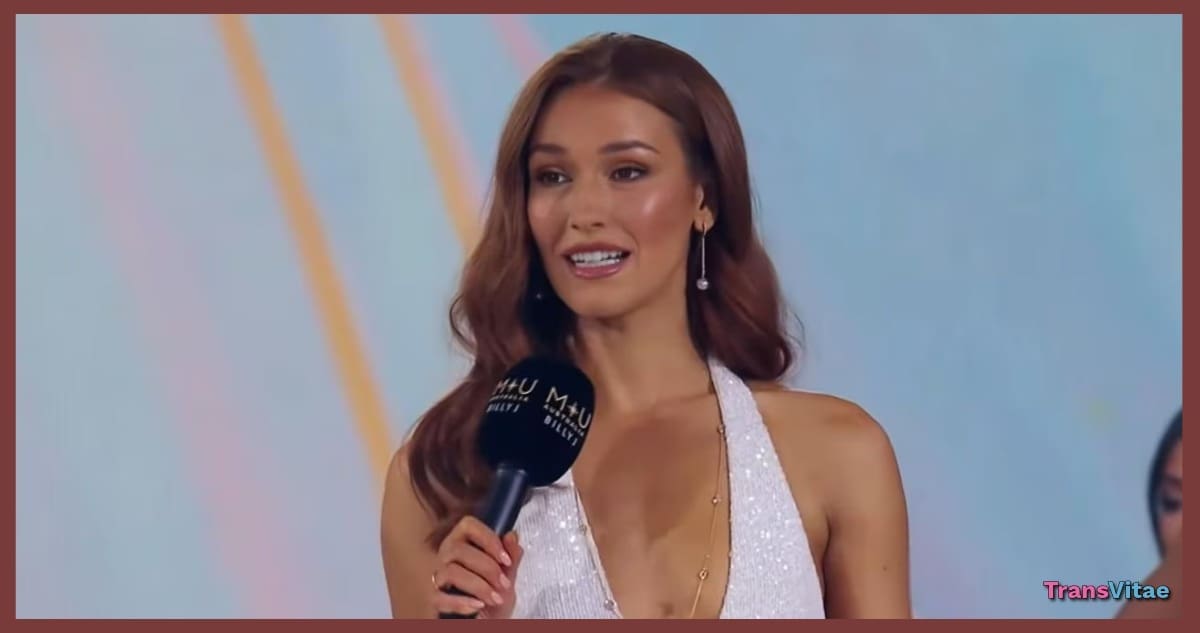
Miss Universe Australia 2026 Caity Worthington has offered her solution to the seemingly endless political debate over transgender athletes: remove them from women’s sports and give transgender people their own category.
There is just one rather significant logistical problem.
You need athletes to have a sports category.
Worthington, a 28-year-old medical radiographer from Brisbane, was crowned Miss Universe Australia Wednesday night at Crown Melbourne. But one of the biggest headlines following her victory has come from her answer to a transgender sports question during the competition.
Worthington was asked whether banning what the question described as “biological males” from women’s sports was “common sense or discrimination.”
That framing matters. Rather than asking contestants how sporting organizations should balance inclusion, fairness and competitive considerations, the question began with language commonly used by opponents of transgender participation and offered contestants a political binary.
Worthington chose her side.
“Human biology does not lie,” she said before arguing that athletes deserve a fair playing field and proposing that transgender athletes eventually compete in their own category. The answer reportedly received enthusiastic applause.
The Math Gets Awkward Quickly
Creating a transgender category can sound like an easy compromise when discussed on television. Attempting to organize one is another matter entirely.
Transgender people make up a small percentage of the population. Transgender elite athletes are an even smaller subset.
Now divide those athletes by sport. Then by competitive level. Then by age divisions, geographic region and, depending on the sport, weight class.
If the proposed transgender category includes both transgender men and transgender women, organizers introduce an entirely new set of physiological questions. If they separate them, the already tiny potential pool gets smaller again.
The result could be less of a competitive division and more of an empty lane. It is one reason the transgender sports debate is considerably more complicated than slogans about “biology” suggest.
Australia Already Has Sporting Policies
Australian sports also do not operate under a single blanket transgender participation rule. Different governing bodies establish eligibility policies appropriate to their competitions.
The Australian Sports Commission promotes participation regardless of gender, sexual orientation, ability or cultural background and has warned that exclusionary policies affecting transgender and gender-diverse people can cause harm beyond those directly excluded.
That does not mean sporting organizations cannot establish eligibility requirements, particularly in elite competition. It means those decisions involve considerably more than declaring that biology “does not lie.”
A Pageant Answer Becomes a Political Headline
Worthington later defended her comments during an appearance with conservative commentator Rita Panahi, saying she would have preferred the traditional beauty-pageant question about world peace but stood behind her position.
“We’re all entitled to our opinions, and we don’t have to agree,” she said.
Worthington will represent Australia at Miss Universe in Puerto Rico this November. She is certainly entitled to her opinion.
But creating an entirely separate sporting category for an exceptionally small population is not simply a question of opinion. Someone eventually has to explain how the proposal would function in the real world.
Because “give trans people their own league” is a remarkably easy answer when nobody asks who they are supposed to compete against.
