


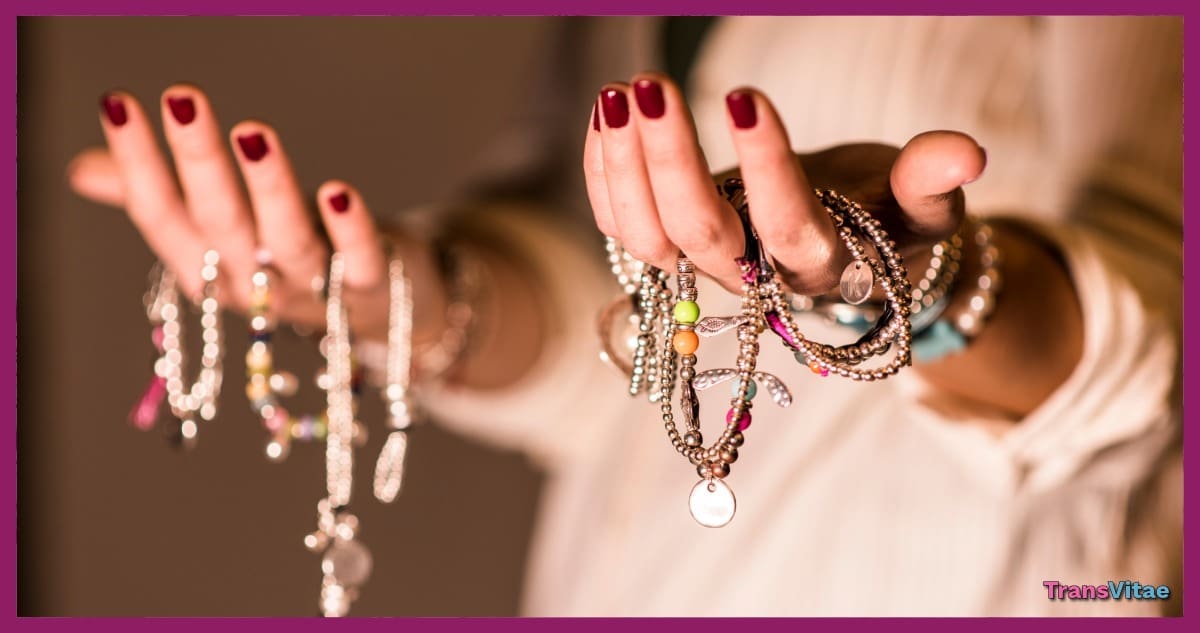
There is a particular kind of fashion betrayal that happens when you spot the perfect bracelet online.
It is delicate without being boring. Feminine without looking like something stolen from a six-year-old’s dress-up box. Maybe it has a tiny heart, a little sparkle, or just enough gold or silver to make your wrist look finished.
You click. You scroll. And then you find the sizing.
Fits wrists up to 6.5 inches.
Well. That’s adorable.
For plenty of trans women, particularly those who transitioned after puberty, wrists can be larger than the dimensions assumed by women’s jewelry manufacturers. Bone structure doesn’t magically shrink when estrogen enters the chat. While hormone therapy can change muscle mass, fat distribution, and the overall appearance of the arms and hands, the circumference created by the underlying bones isn’t going to dramatically transform.
That doesn’t mean bracelets aren’t for you. It means you need to understand how they’re sized. And once you do, shopping becomes considerably less frustrating.
First, Measure Your Wrist. Seriously.
Bracelet shopping gets much easier once you know your actual wrist circumference. Don’t guess. Don’t base it on your watchband. And definitely don’t order something labeled “one size fits most” while whispering “please, please, please” at the checkout screen.
Grab a flexible measuring tape and wrap it around your wrist where you would normally wear a bracelet. The tape should sit against your skin without squeezing it.
No flexible tape? Use a piece of string, ribbon, or even a narrow strip of paper. Wrap it around your wrist, mark where the ends meet, then measure that length against a ruler.
Write the number down.
That is your wrist measurement, not necessarily your bracelet size. The distinction matters.
A bracelet that measures exactly the same circumference as your wrist may technically go around it, but it probably won’t be comfortable. Depending on the style and how you like bracelets to fit, you’ll usually want some additional room.
For a relatively snug fit, adding roughly a quarter to half an inch may be enough. For a more comfortable everyday fit, around half to three-quarters of an inch of additional room is often appropriate. If you like bracelets loose and drapey, you may want even more.
These aren’t commandments carved into the jewelry counter. Bracelet construction, bead size, clasp design and personal preference all affect fit. The important part is knowing your starting number.
Bracelet Length and Wrist Size Are Not the Same Thing
This is one of the easiest mistakes to make when buying jewelry online.
A retailer might list a bracelet as “7.5 inches,” but that measurement can refer to its overall physical length rather than the exact wrist circumference it comfortably accommodates.
Large beads can also change things.
Imagine making a circle out of tiny chain links versus making the same outside circumference from chunky beads. The larger beads take up more space toward the inside of the circle, leaving less room for your wrist.
That’s why two bracelets with identical listed lengths can fit completely differently.
When possible, look for a retailer’s recommended wrist size, not merely the bracelet’s total length.
If that information isn’t available, check reviews. People are remarkably willing to announce their wrist measurements on the internet when jewelry sizing annoys them enough. For once, the comments section may actually save the day.
Chain Bracelets Are Your Friend
For larger wrists, traditional chain bracelets can be among the easiest styles to shop for. The biggest advantage is flexibility.
Many chain bracelets use lobster clasps with several possible attachment points, while others include an extender chain that gives you additional length.
That little dangling chain isn’t merely decorative. It can be the difference between “cute bracelet” and “tiny metallic tourniquet.”
If you find a chain bracelet you love but it’s slightly too short, you may also be able to purchase a separate jewelry extender. These are short sections of chain designed to attach between the existing clasp and bracelet.
Suddenly, a 7-inch bracelet might become 8 inches or longer without requiring any permanent modification. Extenders are particularly useful if you’re still figuring out your jewelry style because they let multiple bracelets share the same solution.
Just pay attention to the hardware.
Match the general metal tone, chain size, and clasp style when possible. An enormous industrial-looking extender attached to a whisper-thin chain technically solves the engineering problem, but aesthetically we’ve wandered into Home Depot couture.
Cuff Bracelets Deserve More Love
Cuffs can be fantastic for larger wrists because they don’t necessarily depend on a clasp or standardized bracelet length. A traditional cuff has an opening that allows the bracelet to slide over the narrower side of the wrist.
But here’s the important part: cuff diameter matters. A cuff labeled “adjustable” isn’t automatically infinitely adjustable.
Some thin metal cuffs can be gently opened or closed to improve fit. Others are made from thicker, rigid material that shouldn’t be repeatedly bent. Constantly flexing metal can weaken it, distort the bracelet, or eventually cause it to break.
Before buying, look for the cuff’s internal diameter, circumference, or wrist-size range.
Also consider the opening.
If the bracelet itself fits your wrist but you practically have to dislocate your hand getting it on, we have not achieved fashion victory.
Once properly sized, though, cuffs are excellent statement pieces. They can be sleek, architectural, delicate, ornate, or unapologetically chunky.
And larger wrists can carry substantial jewelry beautifully.
Bangles Are a Different Beast
Bangles create one of the most common bracelet-sizing problems because many of them aren’t sized according to your wrist at all.
They’re sized according to whether they can get over your hand.
A closed bangle has to pass over the widest part of your compressed hand before reaching your wrist. That means wrist circumference alone doesn’t tell you whether it will fit.
To estimate your bangle size, bring your thumb and little finger toward each other as though you’re trying to slide a bracelet over your hand. Measure around the widest part of your knuckles.
Some jewelry sellers instead use the inside diameter of the bangle, so always check their sizing method.
This is especially important for trans women with larger hands.
You might have a wrist that would comfortably wear a certain bracelet circumference but still be unable to get a corresponding rigid bangle over your hand.
This is not your hand being “too masculine.” It’s geometry. Fortunately, hinged bangles exist.
These open rather than having to slide over the hand, which makes them considerably easier for people with larger hands or prominent knuckles. If you love the clean appearance of a bangle but traditional closed versions never fit, hinged designs are worth hunting down.
Adjustable Doesn’t Always Mean Adjustable Enough
“Adjustable” is one of those lovely fashion words that can mean almost anything. An adjustable bracelet might accommodate several inches of difference. Or approximately twelve molecules.
Sliding bracelets, bolo bracelets, and drawstring designs are often particularly forgiving because the wearer controls the circumference. They’re excellent options when conventional bracelet sizing is problematic.
But check the maximum opening. Remember, some adjustable bracelets still need to pass over your hand before being tightened around the wrist.
Look at the product dimensions rather than trusting the word “adjustable” by itself. The same goes for stretch bracelets.
Elastic can accommodate some variation, but a bracelet designed around a much smaller wrist may stretch enough to technically fit while leaving noticeable gaps between beads, digging into the skin or putting excessive tension on the elastic.
If the beads look like they’re attempting to escape your wrist, you need a larger bracelet.
Don’t Be Afraid of Bracelet Extenders
Jewelry extenders deserve their own little celebration because they’re one of the cheapest solutions to an unnecessarily common problem. They work particularly well with chain bracelets, charm bracelets, and some anklet-style designs.
Yes, anklets.
If you’ve repeatedly found women’s bracelets too small, browse longer bracelet lengths and even some anklets. Depending on the design, nobody knows what category the retailer originally put it in.
The Fashion Police have been severely defunded. A simple chain is a simple chain.
You can also have a jeweler add links to certain bracelets. For an inexpensive fashion piece, that probably isn’t worthwhile. But if you’ve inherited meaningful jewelry or purchased something valuable, professional alteration may be surprisingly straightforward.
Don’t abandon a piece you love before asking whether it can be resized.
Proportion Matters, But Not the Way You’ve Been Told
Trans women frequently encounter style advice framed around making ourselves appear smaller. Smaller hands. Narrower shoulders. Thinner wrists. Less noticeable everything.
It gets exhausting.
You do not have to select the tiniest possible bracelet because someone decided delicate jewelry equals femininity.
In fact, extremely tiny jewelry can sometimes emphasize size differences through contrast. A slightly wider chain, larger charm, layered bracelet stack, or substantial cuff may look more visually balanced on a larger wrist.
That doesn’t mean larger wrists require larger jewelry either. If you love delicate chains, wear delicate chains. The goal isn’t correcting your anatomy. It’s understanding proportion well enough to make an intentional choice.
Try different widths. Stack thin bracelets. Mix a watch with a chain. Wear one dramatic cuff. Combine metals if you want. Jewelry is supposed to be fun, not another gender exam you’re desperately trying to pass.
Watch the Clasp, Too
Bracelet shopping isn’t only about circumference.
Tiny clasps can be frustrating, particularly if you have larger fingers, limited dexterity, long nails, or nobody nearby willing to spend five minutes wrestling with a microscopic lobster clasp.
Magnetic clasps can make bracelets dramatically easier to put on, although they may not be appropriate for every piece or every wearer. Toggle clasps are another convenient option because they tend to be larger and easier to manipulate.
There are also clasp-assist tools designed to hold one end of a bracelet while you fasten the other. Because apparently humanity can put robots on Mars, but fastening a bracelet with one hand remains an advanced-level side quest.
Build Around What Actually Fits
If you’re new to bracelets, resist the temptation to buy ten inexpensive pieces immediately. Start with one or two. Find out what feels comfortable.
Maybe you discover that you hate bangles sliding around your arm. Perhaps cuffs become your thing. Maybe adjustable chains are perfect because you can change the fit depending on where you’re wearing them.
Your preferences matter more than any jewelry guide. And once you find a brand whose sizing works for you, save those measurements. Take screenshots. Make notes.
Women’s clothing sizes may operate according to ancient sorcery, but jewelry measurements can at least give us actual numbers. Use them.
The Bottom Line
There’s a larger lesson buried underneath all these measurements, clasps, and extender chains.
Fashion industries design products around averages, target customers, and manufacturing assumptions. When your body falls outside those assumptions, it’s remarkably easy to internalize the problem.
The bracelet won’t close; therefore, something must be wrong with your wrist. Nope. The bracelet is too small. That’s it.
For trans women, that distinction can matter enormously because we’re already surrounded by messaging encouraging us to scrutinize every millimeter of our bodies for evidence that we aren’t feminine enough.
Your wrist circumference isn’t a femininity score. Neither is your hand size. Neither is whether you need the 8-inch bracelet instead of the 7-inch one.
Measure yourself accurately. Learn which designs give you flexibility. Keep a couple of extenders around. Look for hinged bangles and adjustable cuffs. Ignore arbitrary “one size fits most” labels when you are clearly and fabulously not interested in being statistically average.
Then wear the cute bracelet. Because jewelry should decorate your body. Your body was never supposed to resize itself for the jewelry.
