


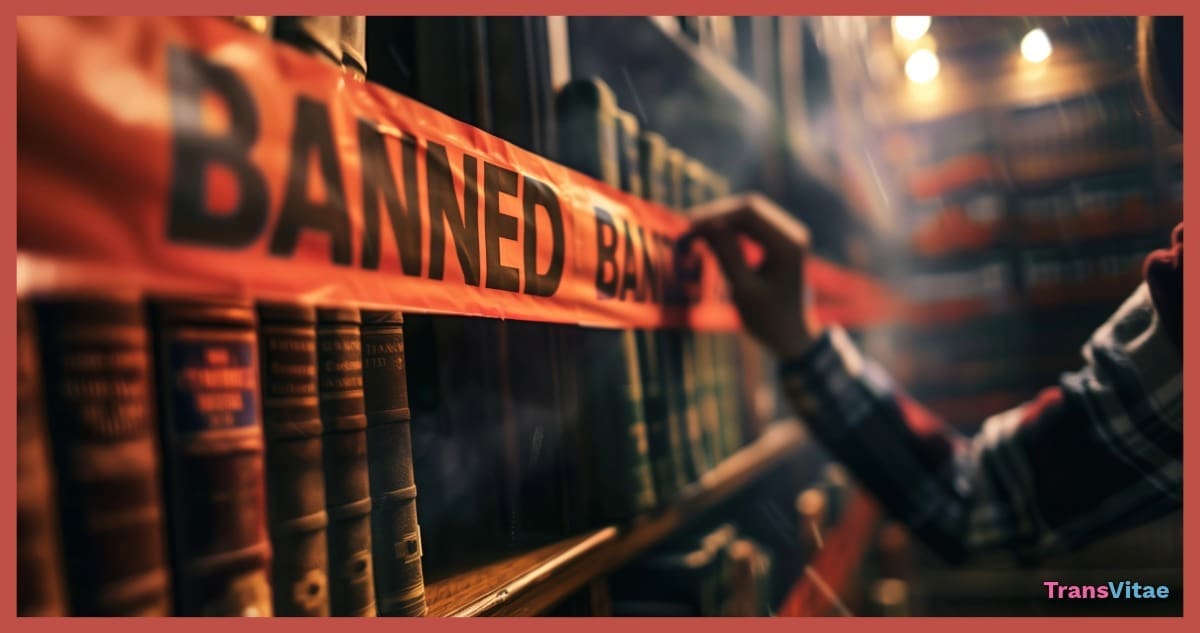
There is something uniquely disturbing about being told your existence belongs in the adult section.
Not pornography. Not an explicit sex manual. Not a graphic novel containing material that would reasonably be inappropriate for a seven-year-old.
Your existence.
A character who is transgender. A book explaining gender identity. A story about a child trying to understand why they feel different. Information about transition. A memoir that tells a transgender person’s story.
In Alabama, those subjects are now enough to get books pushed out of library sections intended for children and teenagers.
The Alabama Public Library Service’s administrative code requires public libraries receiving state aid to keep sections for people under 18 free of material deemed obscene, sexually explicit, or otherwise inappropriate. Then the rule does something remarkable: it specifically declares materials regarding “transgender procedures, gender ideology, or the concept of more than two biological genders” inappropriate for children and youth.
Those materials must be removed from youth sections and either weeded from the collection or relocated to the adult section.
That distinction matters.
Because when the government takes books about a particular group of people and places them alongside materials restricted because of sexual or otherwise adult content, it is not merely organizing shelves.
It is sending a message about the people inside those books. And transgender people have heard that message before.
The Adult Section Is Not the Problem
There is nothing inherently wrong with the adult section of a library. Obviously.
Libraries organize books according to intended readership for perfectly sensible reasons. A 600-page biography written for adults belongs in the adult collection even if its subject is entirely appropriate for children. A complicated medical textbook belongs there because most eight-year-olds are not studying endocrinology.
Age classification itself is not censorship. The problem comes when a book’s intended audience becomes irrelevant because the presence of transgender subject matter automatically overrides it. Alabama’s rule does exactly that.
The state’s administrative code says materials regarding transgender procedures, gender ideology, or more than two biological genders are considered inappropriate for children and youth. Meanwhile, standard library cards issued to minors must restrict them from checking out materials in adult collections unless a parent or guardian provides written consent for broader access.
That means moving a book into the adult section can create an actual barrier between a young reader and that book. This isn’t simply changing its address. It changes who can reach it.
When Identity Gets Confused With Sexuality
There is an old trick buried inside many debates about LGBTQ+ people: take identity and quietly transform it into sexuality.
- A children’s book can show a heterosexual mother and father holding hands without anyone assuming the book is about sex.
- A prince can kiss a princess.
- A teacher can mention her husband.
- A children’s movie can end with the male and female characters falling in love, getting married, and presumably living happily ever after.
Nobody runs screaming toward the adult section. Those things are understood as relationships, families, and ordinary parts of human life. Yet transgender identity is repeatedly subjected to a different standard.
Suddenly, merely acknowledging that transgender people exist becomes something supposedly too mature for young people. But being transgender is not a sex act. A transgender character eating breakfast is not sexual. A transgender teenager going to school is not sexual. A child learning that some people are transgender is not receiving instructions about sexual behavior.
There can certainly be books about transgender people containing sexual material, just as there are books about cisgender people containing sexual material. Those books can be evaluated according to their actual content and intended audience.
That is dramatically different from deciding transgender subject matter itself makes something inappropriate.
What Exactly Are We Protecting Children From?
This is where the logic gets uncomfortable. If a children’s book positively depicts a transgender person living an ordinary life, what exactly makes that inappropriate? If there is no explicit sexual content, what is the danger?
The Alabama rule doesn’t require librarians to demonstrate that every transgender-related book contains graphic sexual material. The state’s current language categorically identifies certain transgender-related subjects as inappropriate for minors.
The practical consequences are already becoming apparent.
Lawrence County Public Library Director Rex Bain told WAFF that the rule’s terminology creates uncertainty about its reach, including whether the presence of a transgender background character could be enough to require relocation. Bain said his library had not received a single complaint about its books during his 13 years as director.
Yet his small staff is now responsible for figuring out how to comply. Libraries have until October 1 to submit updated policies for state review, and libraries that fail to comply can have state aid frozen. In Lawrence County, according to WAFF, that funding represents roughly 22 percent of the library’s budget.
So this isn’t exactly a casual suggestion from the state. There is money attached.
Imagine Applying This Standard to Anyone Else
Sometimes the easiest way to understand a policy is to substitute another group. Imagine a regulation declaring that materials positively depicting people with disabilities were inappropriate for children.
Imagine books mentioning interracial families automatically being moved to adult collections. Imagine deciding that books containing Jewish characters, Muslim characters, or immigrant families needed parental authorization before teenagers could check them out.
People would immediately recognize what the classification communicated. The message would not simply be, “This particular book is intended for adults.”
The message would be that there is something about those people that children should not encounter without supervision. Transgender people deserve the same distinction between identity and content. A book should be evaluated based on what is actually inside it, not because someone like us happens to be inside it.
Libraries Are Where Many of Us First Found Words for Ourselves
For some transgender people, especially those who grew up before transgender representation became relatively accessible online, libraries offered something extraordinarily important. Language.
You can know something about yourself long before you know what to call it. You can know something doesn’t fit. You can stare into a mirror and feel a disconnect you cannot explain. You can watch other girls and experience something deeper than admiration but lack the vocabulary to understand why.
For a young transgender person, discovering a book containing someone with similar feelings can be profound. Not because the book “made” them transgender. Because suddenly they discover they aren’t the only person on Earth who feels that way.
Representation doesn’t manufacture identity. It can provide language for an identity that was already struggling to be understood. That difference gets lost when representation itself is treated as dangerous.
Cisgender Children Benefit From These Books Too
There is another group frequently forgotten in this debate: cisgender children. A child does not need to be transgender to benefit from knowing transgender people exist.
Children eventually encounter people who aren’t exactly like them. That is called living in society.
Books allow children to encounter different families, cultures, religions, disabilities, races, and experiences before meeting those differences in person. They can replace unfamiliarity with understanding.
A cisgender child who reads a story containing a transgender classmate doesn’t become transgender any more than reading a book about someone in a wheelchair makes the reader disabled.
What the child might become is less confused when meeting a transgender person. Maybe even kinder. That seems like a pretty good return on a library card.
The Chilling Effect Goes Beyond Individual Titles
The consequences can also extend beyond books currently sitting on shelves. Alabama’s rules require libraries to adopt selection criteria for materials intended for minors, including restrictions against acquiring material deemed inappropriate.
That raises a larger question: if transgender subject matter is automatically considered inappropriate for youth, why would a library continue buying youth books containing it?
Read Freely Alabama has argued that this could eventually result in books disappearing from collections rather than merely changing shelves. That possibility illustrates why arguments over “relocation” cannot be dismissed as fights over where librarians put stickers on spines.
A restriction can influence purchasing decisions, displays, recommendations, and collection development long before anyone officially bans a title.
PEN America’s September report on public-library censorship describes a broader environment in which libraries are facing political interference involving collections, displays, programming, governance, and funding.
Alabama is one part of that larger battle.
Parents Already Have Enormous Power
Supporters of these restrictions frequently frame them as parental-rights measures. Parents absolutely should guide what their own children read. They can accompany their children to the library. They can look at what their children check out. They can tell their children certain books are off limits. They can discuss difficult subjects according to their family’s beliefs. They can even decide their child won’t use the library.
What parental authority should not automatically mean is authority over everybody else’s child. That distinction matters in a public institution serving families with dramatically different beliefs.
One parent may believe transgender identities conflict with their religious beliefs. Another may have a transgender daughter. Both families use the same library.
The library does not need to settle their philosophical disagreement. It can provide information and allow each family to decide what its own children read. That is what libraries are exceptionally good at doing.
Transgender Children Don’t Stop Existing When the Books Move
There is also a reality no shelving policy can change. Transgender young people exist. Some know very early. Others figure it out during adolescence. Some don’t understand themselves until adulthood.
Moving books cannot change that.
What it can change is whether young people have reliable, age-appropriate information available while trying to understand themselves or someone they know.
Briar Wolf, a transgender Alabama resident, told WAFF that growing up in the state meant having virtually no positive representation of people like them.
That absence matters. When adults deliberately remove representation, silence becomes its own lesson. Children notice which lives appear in their books. They also notice which lives mysteriously disappear.
The Bottom Line
Perhaps that is the most troubling part of policies like Alabama’s. For transgender adults, this rhetoric is painfully familiar.
Many of us spent years hiding. We hid clothing. We hid feelings. We hid browser histories. We hid photographs. We changed the way we walked, talked, or sat. We carefully edited ourselves because we learned that being discovered could have consequences.
Some of us became extraordinarily good at disappearing while standing directly in front of people. Eventually, many of us fought our way out of that hiding place. And now we are watching governments tell libraries that books acknowledging people like us belong somewhere children won’t casually encounter them.
That carries symbolism whether policymakers acknowledge it or not. Put us somewhere else. Move us out of sight. Require permission before young people encounter us. Treat our stories as something fundamentally different from everyone else’s.
But transgender people are already part of children’s lives. We are their parents. Their aunts and uncles. Their teachers. Their neighbors. Their older siblings. Their classmates.
And sometimes, yes, they are transgender themselves. No bookshelf arrangement changes that.
Libraries should absolutely make thoughtful decisions about age-appropriate content. Librarians have been doing exactly that for generations. But age appropriateness should depend on what a book actually contains. Not on whether someone like us appears between its covers. Because transgender people are not adult content.
Our lives are not obscene. Our existence does not require a warning label. And we should not have to spend another generation watching ourselves be hidden away.
