


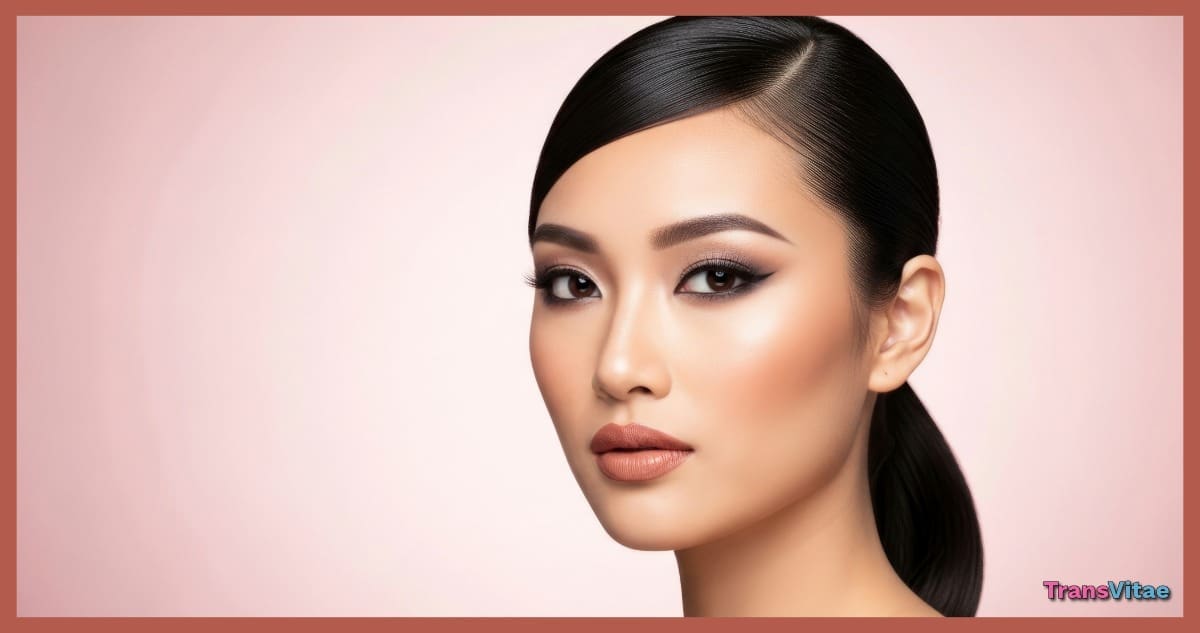
For several years, the internet tried very hard to convince us that putting your hair slightly to the left was evidence that you remembered dial-up internet.
The middle part became the unofficial hairstyle of youth. TikTok declared the side part dated. Gen Z planted a flag directly in the center of the scalp, while millennials quietly wondered when hair placement had become a generational identity crisis.
Well, dig out the skinny jeans. Okay, maybe not those.
The side part is creeping back into fashion, joining the broader return of late-1990s and 2000s beauty influences appearing in hair and makeup trends. And for trans women, particularly those experimenting with hairstyles during transition, this is more than another round of fashion recycling.
Where you part your hair can dramatically change how your face appears.
A part can affect the apparent width of your forehead, soften a prominent hairline, change where volume sits around the face, emphasize cheekbones, balance facial proportions, and even make thinning areas more or less noticeable.
And unlike contouring, extensions, or a $300 salon appointment, moving your part approximately two inches costs exactly zero dollars. Welcome back, side part. Some of us never stopped believing.
First, There Is Nothing Inherently Feminine About a Side Part
Before we turn hair into geometry class, we need to get something straight. There is no objectively feminine hair part.
A middle part doesn’t make someone masculine. A side part doesn’t make someone feminine. Neither one determines whether someone passes, and neither should become another ridiculous beauty rule trans women feel obligated to follow.
The goal isn’t to disguise your face until it conforms to some imaginary template of womanhood. The useful question is much simpler: What does changing your part do visually, and do you like the result?
Hair is one of the easiest ways to manipulate visual proportions because it creates lines, volume, and framing around the face. Move those elements and the face can appear different even though absolutely nothing about the face itself has changed.
That’s why experimenting with your part can be particularly useful during transition.
Your hairstyle may be changing. Your hairline may be changing. Your face may be changing on hormone therapy. You may simply be growing your hair longer for the first time and discovering that the hairstyle you’ve worn since high school no longer makes sense.
There is no requirement to feminize anything. But there is absolutely nothing wrong with understanding the tools available to you.
Why the Side Part Changes Your Face
A center part creates symmetry. It essentially draws an invisible vertical line down the middle of the face while placing relatively equal amounts of hair on both sides. That can be gorgeous. It can emphasize symmetry, cheekbones, and the natural shape of the face.
But symmetry also means exposure.
A center part tends to reveal more of the forehead and hairline. Depending on the haircut, it can also create two relatively straight vertical curtains running alongside the face.
A side part disrupts that symmetry.
Instead of the eye immediately traveling straight down the center, the hair moves diagonally across the upper portion of the face. One side generally gains more volume while the other becomes more exposed.
That asymmetry can change how facial proportions are perceived.
A deeper side part can visually reduce the amount of exposed forehead. Volume near the temples can alter the perceived width of the upper face. Layers sweeping across the forehead can soften the transition between hairline and face.
Basically, you’re playing an optical illusion with keratin. And unlike questionable TikTok contour hacks involving six shades of concealer and something resembling architectural drafting, this one is pretty difficult to screw up.
The Hairline Question
Hairlines can be a sensitive subject for trans women.
Some of us begin transition after experiencing years of androgen-related hair loss. Others have naturally higher hairlines or recession around the temples. Some experience significant regrowth after testosterone suppression and hormone therapy, while others see relatively little.
Hair transplantation, wigs, toppers, fibers, and other options exist, but simple styling can also make a substantial difference.
A center part can sometimes emphasize temple recession because both sides of the frontal hairline remain visible. Moving the part slightly off-center can break up that visual pattern. A deeper side part can go further by allowing hair to sweep across one side of the forehead, potentially covering areas where density is lower.
The important word here is potentially.
If your hair is thinning, aggressively forcing hair from one side across the entire scalp can sometimes create the opposite effect. Thin strands stretched across visible scalp rarely fool anyone, and they can draw more attention to the area you’re trying to minimize.
Think soft movement, not 1987 comb-over. Try shifting your part gradually.
If you’ve worn it directly in the middle, move it half an inch. Look at yourself from the front, side, and three-quarter angle. Then try another half inch.
You may discover that the best position isn’t a dramatic side part at all. It might simply be slightly off-center.
Your Forehead Isn’t Too Big
This deserves its own section because beauty advice has an annoying habit of turning every facial feature into a problem requiring correction.
Your forehead is not defective.
Neither is a strong jaw, prominent brow, long face, square face, or anything else beauty articles have spent decades teaching women to dislike.
But if you want to change how prominent your forehead appears, your hairstyle can do that.
A deep center part combined with flat hair can visually create a long uninterrupted line from the top of the head through the chin. For someone with a longer face, that can sometimes emphasize vertical length.
A side part introduces diagonal movement. Add some volume near the temples or cheekbones, and the eye starts moving outward rather than exclusively downward.
The effect can make the face appear somewhat wider and, therefore, proportionally shorter.
This is also why layers matter. A side part with completely flat, one-length hair behaves differently from a side part with soft layers around the cheekbones and jaw.
You’re not simply choosing where your scalp line goes. You’re deciding where the visual weight of the hairstyle sits.
Face Shape Is a Guide, Not a Law
Search for “best hair part for face shape” and you’ll encounter enough contradictory charts to make you question whether anyone on the internet has ever seen a human head.
Round faces supposedly need this. Square faces supposedly need that. Heart-shaped faces apparently require a specific subsection of trigonometry. Use face-shape advice as a starting point, not scripture.
Generally, side parts can introduce asymmetry and diagonal lines that soften strongly geometric facial shapes. They can also add volume to one side, which may help balance a long or narrow face.
But hair texture, density, length, layers, forehead shape, and personal style matter just as much.
Two women with supposedly “square” faces may look completely different with identical hairstyles. This is especially relevant for trans women because traditional face-shape guides weren’t written with transition in mind.
Hormone therapy can gradually change facial appearance through shifts in skin, fat distribution, and soft tissue. It doesn’t magically rebuild adult facial bones, but changes around the cheeks and other areas can affect how the face is perceived.
The hairstyle that looked best during your first six months of transition may not be the hairstyle you prefer three years later. Give yourself permission to experiment.
The Side Part Can Add Volume
Here’s another advantage that has nothing to do with facial feminization. Moving your part can make your hair look fuller.
Hair becomes accustomed to lying in a particular direction. When you repeatedly part it in the same location, the roots tend to flatten accordingly.
Flip the hair in the opposite direction, and those roots suddenly have resistance. Hello, volume. This can be especially useful for fine hair or hair that has lost density.
Try creating your side part while the hair is damp, then blow-dry the roots in the opposite direction from where they naturally fall. Once dry, flip the hair back into position.
You can also use a small amount of volumizing mousse or root-lifting product, but don’t assume more product equals more volume. Too much product can weigh fine hair down. Gravity remains undefeated.
Side Part, Slight Side Part or Full Drama?
Not all side parts are created equal. A slightly off-center part is the gateway drug.
It preserves much of the balance of a center part while introducing a little asymmetry. If you’re nervous about changing your hairstyle dramatically, start here.
A standard side part usually begins somewhere around the inner-to-middle portion of the eyebrow. It creates more noticeable volume and movement while still looking natural.
Then there’s the deep side part. That’s the glamorous one.
Placed closer to the outer portion of the eyebrow, it creates a much stronger sweep across the forehead and can produce significant volume on one side.
Think red carpet rather than Monday morning Zoom meeting. Although, frankly, your coworkers could probably use the excitement.
Curly and Textured Hair Plays by Different Rules
Much of the conversation around hair parts assumes straight or slightly wavy hair. Curly hair would like a word.
With curls, the “perfect” straight part isn’t necessarily desirable. A slightly irregular or zigzag part can help prevent scalp visibility and create more natural volume.
Changing the part can also disrupt established curl clumps, so don’t expect hair that has spent years falling one direction to immediately cooperate.
Try changing the part while the hair is wet and styling your curls from that position. You may need several wash cycles before the new pattern begins feeling natural. And if your curls strongly insist on falling somewhere else?
Sometimes the curls win. Respect the union.
Growing Your Hair Out? Experiment Now
Early transition often comes with the Great Hair-Growing Experiment. You start with short hair. Then slightly longer short hair. Then there’s an unfortunate period where your hair appears to have entered negotiations with management.
Eventually, it reaches a length where suddenly you have options. This awkward stage is actually an excellent time to experiment with parts.
A different part can change how short layers fall around the forehead and temples. It can help incorporate growing bangs. It can make uneven lengths look intentional rather than evidence that you’re avoiding your stylist.
Take photos as you experiment. Don’t rely entirely on the bathroom mirror.
Look at yourself from multiple angles and in different lighting. A hairstyle that seems strange because you’re unfamiliar with it may photograph beautifully once your brain stops screaming, “THIS IS NOT WHERE THE HAIR GOES.”
Give it a day.
The Bottom Line
The funniest part of the entire side-part debate is that millions of people allowed social media to convince them that a line on their scalp had an expiration date.
Beauty trends are cyclical. Middle parts were fashionable. Then side parts. Then middle parts again. Now side parts are returning. Give fashion another decade and someone will confidently announce that bangs have been discovered.
Trends can be fun. They give us excuses to experiment and occasionally rediscover something we abandoned years ago. But they shouldn’t dictate how you present yourself.
For trans women in particular, beauty can already become exhausting when every choice starts feeling connected to passing, femininity, or validation. Your hair doesn’t need that pressure.
Move your part because you like how it frames your cheekbones. Move it because it gives you more volume. Move it because it makes your hairline less noticeable. Move it because you saw someone looking fabulous and thought, “Yep. Stealing that.” Or keep your middle part because you love it.
The beauty police are currently understaffed. The side part may officially be fashionable again, but the better lesson is simpler.
Your face isn’t a trend. Your hair isn’t an obligation. And sometimes the cheapest beauty transformation available really is moving a comb two inches to the left.
