


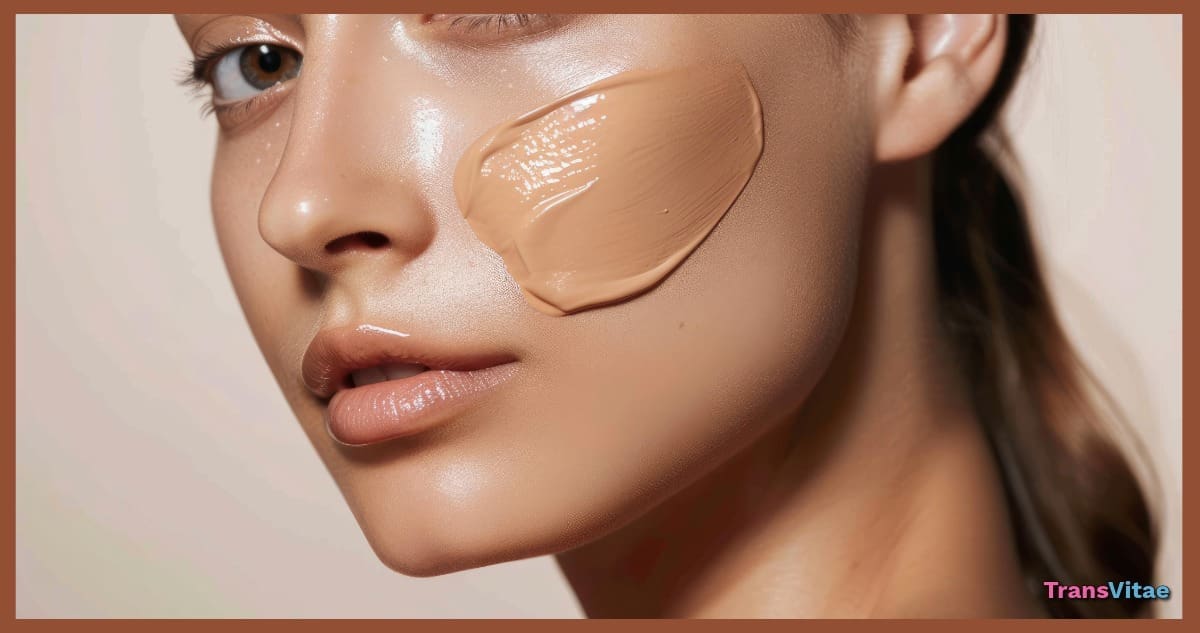
You bought your foundation in May. You swatched it carefully. You checked it in natural light. You blended it down your jaw, admired your handiwork, and congratulated yourself on finally finding The One.
Now it’s late August, and suddenly your face looks like it was borrowed from another person. What happened?
Probably nothing dramatic. Your foundation didn’t betray you. Your skin changed.
By the end of summer, even people who religiously wear sunscreen can experience subtle changes in skin depth and tone. Add heat, humidity, changes in skincare, more time outside, vacation sun, different levels of hydration, and the occasional “I’m only walking from the car to Target” decision to skip SPF, and the foundation that looked perfect three months ago may no longer be quite right.
For trans women who rely on foundation and color correction to manage beard shadow, redness, discoloration, or simply create a smoother canvas, a small mismatch can become especially noticeable.
Before tossing a perfectly good bottle into makeup purgatory and spending another $50, it’s worth figuring out exactly what changed.
Your Skin Isn’t One Permanent Color
We tend to talk about foundation shades as though they’re blood types. “I’m a 3N.” “I’m medium neutral.” “I’m 220.” Great. Until you’re not.
Your underlying skin characteristics don’t typically transform every season, but the visible depth and surface tone of your complexion absolutely can.
Sun exposure stimulates melanin production, which can deepen the appearance of your skin. You don’t necessarily need to spend two weeks roasting beside a pool for this to happen. Regular walks, driving, gardening, outdoor dining, festivals, Pride events, photography trips, or simply living your life during summer can gradually affect exposed skin.
And your face isn’t necessarily changing at the same rate as the rest of you.
If you’re diligent about facial SPF but less diligent on your neck and chest, those areas can become darker than your face. If you’re wearing hats all summer, the opposite can happen. Suddenly the foundation matched to your jaw in spring creates a visible divide between your face and neck.
Congratulations. Your body has invented its own gradient.
That’s why a late-summer foundation reset isn’t necessarily about finding a completely different product. It’s about understanding what you’re actually trying to match.
Depth and Undertone Are Not the Same Thing
Foundation matching gets much easier once you separate two concepts: depth and undertone.
Depth is essentially how light or dark the foundation is.
Undertone describes the subtle color underneath that depth. Brands generally categorize undertones as cool, warm, neutral, olive, or variations of those categories.
Cool skin may lean pink, red, or bluish. Warm skin tends toward golden, yellow, or peach tones. Olive complexions can have greenish or muted golden characteristics. Neutral skin sits somewhere between the traditional warm and cool categories.
Summer frequently changes depth more noticeably than it changes your fundamental undertone.
That’s an important distinction.
If your normally neutral complexion becomes slightly deeper from summer sun, buying a warmer foundation simply because your skin looks “more golden” can leave you looking orange. You may actually need the same general undertone in a slightly deeper shade.
This is also why matching foundation exclusively to your hand is unreliable. Your hands receive different amounts of sun, have different skin thickness, and may be noticeably different from your face and neck.
Instead, test foundation along the lower cheek and jawline and look at how it transitions toward the neck. The winner should practically disappear.
Then There’s Oxidation
Sometimes your shade hasn’t changed at all. Your foundation has.
If you’ve ever applied foundation that looked perfect and then discovered 30 minutes later that you’ve become inexplicably orange, you’ve probably encountered oxidation.
Foundation can change color after application as its ingredients interact with air, oils on your skin, skincare products, and other cosmetics. The effect varies considerably between formulas and individuals.
This means swatching a foundation and immediately declaring victory can be risky. Apply your test shade and give it some time. Walk around the store. Look at something you absolutely don’t need. Pretend you’re not going to buy it. Buy it anyway. Then check your foundation again.
Ideally, examine it in natural daylight after it has been sitting on your skin for 15 to 30 minutes. If the fresh application matches but the dried-down foundation becomes noticeably darker, warmer, or more orange, going slightly lighter may compensate for that particular formula.
But don’t automatically buy a lighter shade whenever oxidation occurs. Significant oxidation can also mean that the formula simply doesn’t cooperate with your skin or skincare routine.
Skincare Can Change the Equation
Your summer skincare routine may be completely different from the one you used in spring.
Maybe you’re using a lighter moisturizer. Perhaps you’ve increased sunscreen use. You might be using niacinamide, vitamin C, retinoids, exfoliating acids, or products intended to address hyperpigmentation.
Those changes can alter how foundation sits on the skin even when they aren’t dramatically changing your actual complexion.
Oil production matters too. Hot weather can make some people’s skin considerably oilier. Others become dehydrated from air conditioning, sun exposure, swimming, travel, or simply not drinking enough water.
A foundation that looked smooth in May might separate around your nose in August. A matte formula that behaved beautifully during spring may suddenly cling to dehydrated patches.
That can create the illusion of a color mismatch because uneven texture changes how light reflects from the face.
Before replacing your shade, ask another question: Is the color wrong, or does the foundation just look wrong? Those aren’t always the same problem.
Beard Shadow Complicates Foundation Matching
For many trans women, there’s another layer to the situation: facial hair. Beard shadow can introduce blue, gray, green, or purple tones beneath the skin. Even after an extremely close shave, pigment below the surface may remain visible.
That can distort your perception of your actual foundation shade. The instinct is often to compensate by choosing a warmer or heavier foundation. That’s usually not the best approach.
Foundation should primarily match your complexion. Color corrector should handle unwanted color underneath it.
Depending on skin depth and the color of the shadow, peach, orange, or reddish correctors can help neutralize blue or gray tones before foundation is applied.
And here’s where summer gets interesting.
If your skin becomes deeper while you’re still using the same corrector and foundation combination from spring, the proportions may stop working. A pale peach corrector that disappeared beautifully under your May foundation might suddenly look chalky. An orange corrector applied too heavily may begin showing through a lighter foundation that no longer matches your surrounding skin.
Don’t immediately add more foundation. Reassess the whole combination. Sometimes the solution is simply using less corrector.
RELATED: Color Correcting 101: A Trans Woman’s Guide to Flawless Skin
Don’t Replace It. Adjust It.
Suppose your favorite foundation is now slightly too light. You don’t necessarily need to retire it until winter. One of the easiest solutions is mixing it with a deeper shade.
If you already own another foundation with a similar undertone, put a small amount of each on a clean mixing surface or the back of your hand and adjust the ratio until the result matches.
There are also foundation mixing pigments and shade-adjusting drops specifically designed to alter depth or tone without dramatically changing the formula.
The important word here is small. We’re adjusting foundation, not making soup. Add tiny amounts, mix thoroughly, test along the jaw, and allow the mixture to dry down before making another adjustment.
You can also strategically use bronzer to bridge a minor mismatch. If your foundation is only slightly lighter than your late-summer complexion, a softly applied bronzer around the perimeter of the face, temples, cheekbones, and jaw can restore dimension and make the overall complexion appear more cohesive.
That doesn’t mean covering your entire face in bronzer until the foundation submits. Subtlety wins.
What If Your Foundation Is Too Dark?
Save it. Seriously.
If your late-summer foundation matches perfectly now but becomes too dark in November, don’t throw it away. Seasonal complexion changes often mean that owning two nearby shades is more useful than endlessly searching for one magical bottle that works 365 days a year.
A lighter winter foundation and slightly deeper summer shade can also be mixed during transitional months. September might be 60% summer shade and 40% winter shade. October may reverse that.
Congratulations, you’re now your own tiny cosmetics laboratory.
Just pay attention to expiration dates and changes in smell, texture, separation, or performance. Makeup does not become immortal simply because the shade might be useful again someday.
Match Your Neck, But Look at the Whole Picture
You’ve probably heard that foundation should match your neck. That’s generally useful advice, but it isn’t an absolute law.
Your face, neck, chest, and shoulders can all be different colors, particularly after summer. Matching an unusually pale neck exactly could make your face look disconnected from a more sun-exposed chest.
Instead, think about visual continuity.
Stand in natural light and look at yourself from several feet away. Does your face appear connected to the rest of your visible skin, or does it look like a beautifully blended mask?
If you’re wearing a low neckline, consider the chest too. The goal isn’t mathematical color equality. It’s making the transition between areas look intentional and natural.
Check Your Makeup in Actual Daylight
Bathroom lighting is a liar.
Some bulbs are extremely warm. Others are brutally cool. Ring lights can flatten the complexion and make makeup look fantastic directly in front of them while daylight reveals an entirely different situation.
Once you’ve finished your makeup, stand near a window. Better yet, go outside with a mirror. Don’t judge yourself. Judge the makeup.
Look at the jawline, hairline, around the ears, and transition into the neck. Those are usually the areas where a mismatch announces itself. Taking a quick phone photo in indirect daylight can help too. Sometimes differences in tone become easier to spot in a photograph than in the mirror.
And if you discover your match isn’t perfect? Good. Now you know. That’s information, not failure.
The Bottom Line
Foundation matching can carry extra emotional weight for trans women because makeup is so frequently presented as a tool for “fixing” features, hiding evidence of transition, or helping someone pass.
That pressure can turn a slightly wrong foundation shade into something much bigger than it needs to be. Your makeup doesn’t have to fool anyone.
It doesn’t have to erase every pore, cover every trace of facial hair, reshape your skull, or prove that you understand some secret version of femininity everyone else supposedly learned in middle school.
Makeup is a skill. Skills take practice.
And even cis women who have been wearing foundation for decades routinely walk out of stores with the wrong shade. The cosmetics industry wouldn’t manufacture dozens of shades, undertones, mixers, primers, powders, and correctors if everybody instinctively knew what they were doing.
Late August is simply a good time to recalibrate.
Take another look at your foundation. Check your depth. Reconsider your undertone. See whether your formula oxidizes. Examine how your skincare is interacting with it. Adjust your corrector if necessary.
And before dropping another chunk of your paycheck at the beauty counter, experiment with what you already own. Because sometimes your favorite foundation hasn’t stopped working. Summer just moved the goalposts half a shade.
