


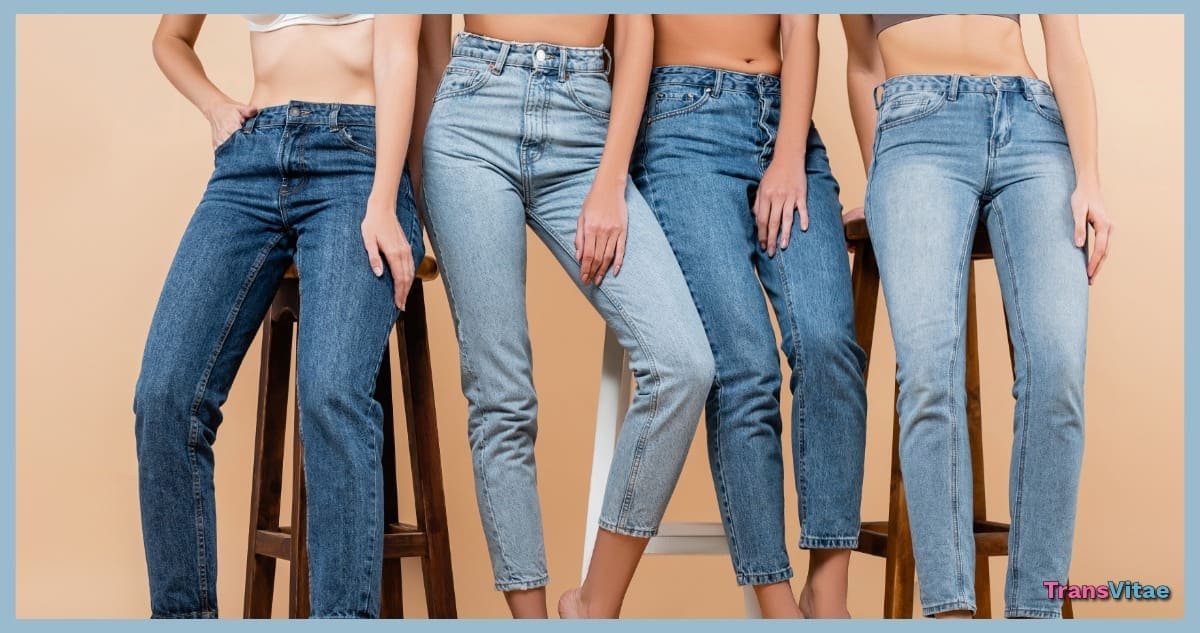
There are certain milestones in transition nobody really prepares you for. Starting hormones. Coming out. Hearing your name spoken naturally by people you love. Looking in the mirror one random Tuesday and realizing something has changed.
And then there is buying women’s jeans.
Welcome to hell.
If you spent years buying men’s jeans, you probably remember a beautifully simple system: waist and inseam. A 34×32 was a 34-inch waist with a 32-inch inseam. Was it perfect? No. But at least everyone involved appeared to understand how numbers work.
Then you cross into the women’s department and discover a lawless wasteland where you might be an 8, 10, 12, 14, 31, large, or apparently something called a “curvy 10.” None of these numbers are required to have any relationship with your actual body.
Better yet, you can wear a size 10 at one store, a 14 somewhere else and somehow need a 12 and a prayer at a third.
For transgender women, figuring out jeans can be particularly frustrating because many of us are learning an unfamiliar sizing system while simultaneously dealing with proportions that clothing manufacturers don’t always account for.
So let’s make jeans slightly less ridiculous.
First Rule: Ignore the Number on the Tag
This might be the most important thing you learn about women’s clothing. Your clothing size is not a measurement of your body, femininity, attractiveness, or transition. It’s inventory information. That’s it.
Women’s sizing varies enormously between brands and sometimes even between different styles from the same brand. Vanity sizing, fabric composition, cut, and target demographic can all affect which number ends up sewn into the waistband.
If a size 14 fits beautifully, buy the 14.
Nobody walking past you knows what’s printed on the tag inside your pants. And if someone does know, you’ve probably got much bigger questions about why they’re currently inside your jeans.
The goal isn’t fitting into the smallest possible size. The goal is finding jeans that fit your body. Those are very different things.
Start With Actual Measurements
Before shopping online or walking into a store, grab a flexible measuring tape. You primarily want three measurements: waist, hips and inseam.
Measure your natural waist around the narrowest part of your torso, generally somewhere above your belly button. Don’t suck your stomach in like you’re trying to impress somebody at the beach. You want the measurement of the body you’re actually dressing.
Next, measure around the fullest part of your hips and butt.
This measurement can be particularly important for transgender women because our waist-to-hip proportions may differ from the fit model a particular clothing company uses.
Finally, measure your inseam from the crotch down the inside of your leg to approximately where you’d like your jeans to end.
Write these numbers down. When shopping online, ignore the model wearing a size 4 while standing in a wind tunnel looking mysteriously disappointed with Paris.
Open the brand’s actual sizing chart. Measurements are usually much more useful than guessing based on the size you wore somewhere else.
Rise Changes Everything
One of the biggest differences you’ll encounter in women’s jeans is rise. Rise describes the distance between the crotch seam and the waistband.
You’ll generally encounter low-rise, mid-rise, and high-rise jeans.
- Low-rise jeans sit lower on the hips. Yes, they’re back. Fashion apparently decided some of us had become too comfortable.
- Mid-rise jeans usually sit somewhere around or slightly below the natural waist and are often an easy everyday option.
- High-rise jeans sit higher around the waist and can completely change your silhouette.
For many trans women, mid- and high-rise jeans can be especially useful because they visually lengthen the legs and create more definition between the waist and hips.
But there isn’t a universal “best” rise for trans bodies. Torso length matters.
If you have a shorter torso, extremely high-rise jeans can feel like the waistband is attempting to meet your bra. If you have a long torso, something marketed as high-rise might barely reach your belly button.
Try different rises and look at your overall proportions rather than automatically choosing whatever TikTok declared fashionable this week.
Straight, Skinny, Bootcut, Flare, Wide-Leg…Oh My
Once you’ve survived sizing and rise, fashion presents another boss battle: leg shape.
- Skinny jeans fit closely from the hip through the ankle. They’re no longer the undisputed ruler of denim, but despite repeated declarations of their death, millions of pairs remain stubbornly alive.
- Straight-leg jeans fall relatively straight from the thigh downward. They’re versatile, easy to style and flattering on a huge range of bodies.
- Bootcut jeans remain relatively fitted through the thigh before widening slightly below the knee. That subtle flare can help visually balance broader shoulders.
- Flared jeans take that concept further and bring more visual weight toward the bottom of the body. Yes, the ’70s continue refusing to stay dead.
- Wide-leg jeans create a looser silhouette from the hips downward. They can be fantastic for creating movement and balancing proportions, especially when paired with a more fitted or structured top.
- Boyfriend and relaxed jeans generally offer more room through the hips and legs. These can be comfortable options, but watch the overall proportions if you’re trying to create more waist definition.
None of these styles is inherently more feminine than another. The question is what silhouette makes you look in the mirror and think, Yep. That’s the outfit.
Stretch Percentage Is Secretly Important
Here’s something beginners often overlook: check the fabric label. Denim containing elastane or spandex will behave differently than traditional 100-percent cotton denim. Even 1 or 2 percent stretch can make jeans dramatically more forgiving.
Stretch denim can be particularly helpful if your waist, hips, and thighs don’t perfectly match the proportions assumed by the manufacturer. It can also make fitted styles significantly more comfortable.
But more stretch isn’t automatically better.
Very stretchy jeans can lose their shape throughout the day, especially around the knees, butt and waistband. Meanwhile, rigid denim can look fantastic and develop a personalized fit over time but may initially feel considerably less forgiving.
If you’re buying jeans online, fabric composition is one of those tiny details worth checking.
The Waist-to-Hip Problem
One common frustration for trans women is finding jeans that fit the waist and hips simultaneously. You might find a pair that fits your waist perfectly but leaves excess fabric around the hips. Or the hips look fantastic while the waistband threatens your internal organs.
Neither means there’s something wrong with your body.
It means mass-produced clothing was designed around standardized proportions, and human beings stubbornly refuse to come standardized.
Look for cuts described as straight, classic, or slim through the hips if you have less difference between your waist and hip measurements.
Conversely, if HRT, genetics, or simply the body lottery has given you more hip and butt development, curvy cuts may fit better. Curvy jeans typically assume a larger difference between waist and hip measurements.
Again, forget the label. Wear the cut designed for your proportions.
HRT May Change Your Jeans Situation
If you’re taking feminizing hormone therapy, the jeans that fit today may not fit exactly the same way two years from now. Hormone therapy can affect body composition over time, although the degree and timing vary significantly from person to person.
Changes in muscle mass and fat distribution may alter the way clothing sits around your thighs, waist, hips, and butt. Your weight might remain relatively stable while your proportions change enough that familiar clothing suddenly fits differently.
This is one reason newly transitioning women might want to resist immediately spending a small fortune on premium denim.
Build gradually. Your style is probably evolving alongside your body anyway. That $200 pair of designer jeans isn’t going anywhere. Give yourself time to figure out what you actually like.
Let’s Talk About the Front
For some trans women, the front of women’s jeans creates another concern: genital visibility. Women’s pants are generally cut differently through the crotch than men’s pants, and tight denim can make that difference noticeable.
Whether you tuck is entirely personal. Some women tuck regularly. Some only tuck with certain outfits. Some never tuck at all. Your wardrobe does not get to issue gender requirements.
If front visibility concerns you, thicker denim, darker washes, patterned fabrics, relaxed cuts, and jeans with more room through the rise can make things less noticeable.
Longer tops and layering can also change the visual focus of an outfit. The important thing is comfort. You shouldn’t have to spend an entire day physically miserable because you believe femininity requires your body to become geometrically flat.
Length Can Be Surprisingly Tricky
Tall trans women often discover another woman’s fashion tradition: apparently designers think women stop having legs at a certain height. Fortunately, more brands now offer short, regular, and tall inseams.
Pay attention to the actual inseam measurement rather than relying solely on those labels. Your ideal length also depends on the style.
Skinny jeans often end around the ankle. Straight-leg jeans can work cropped or full length. Wide-leg and flare styles generally need enough length to create their intended silhouette without dragging across every parking lot in America.
Shoes matter too. A pair of flares that looks perfect with heels may become a denim street sweeper when worn with sneakers. Consider what shoes you’ll realistically wear with the jeans before deciding on length.
The Fitting Room Is Data Collection
Trying on women’s clothes for the first time can be intimidating, particularly if you’re worried about being judged or don’t feel completely confident shopping in the women’s department.
But fitting rooms are where you learn. Bring several sizes. Seriously.
If you think you’re a 12, grab the 10, 12 and 14. You’re not admitting defeat by trying a larger size. You’re testing three pieces of fabric manufactured in a factory.
Move around. Sit down. Squat. Walk. Check the waistband. Look at the back.
Put your phone in the pocket and discover women’s pockets were apparently designed by someone with a personal vendetta against objects. Most importantly, notice how you feel. Good jeans shouldn’t require constant adjusting, pulling, sucking in, or negotiating.
Tailoring Isn’t Just for Expensive Clothes
Sometimes the closest-fitting pair still isn’t perfect. That’s where alterations come in.
Having the waist taken in, adjusting the hem or making other relatively simple alterations can transform an okay pair of jeans into something that looks custom.
Trans women sometimes fall into the trap of believing our bodies must conform to women’s clothing. Reverse that equation. Clothing is supposed to fit you.
Tailors have been altering women’s clothing to fit individual bodies forever. Cis women aren’t magically shaped like department-store mannequins either.
Build Your Denim Collection Slowly
You don’t need twelve pairs of jeans. Start with two or three versatile options.
A darker straight-leg jean can handle casual outfits, dinners, and even some business-casual environments. A lighter wash provides an easy everyday option. Then add something with personality: wide-leg, flare, distressed, black denim, or whatever fits your style.
Eventually you’ll learn which brands understand your proportions. That’s when shopping gets dramatically easier.
You’ll know that one company’s 12 fits like another company’s 14. You’ll know which rise works with your torso. You’ll know whether you want stretch. You’ll know your inseam.
Women’s sizing will still make absolutely no sense. You’ll just become better at defeating it.
The Bottom Line
Fashion can become weirdly emotional during transition. A waistband can somehow turn into a referendum on femininity. A fitting-room mirror can become an enemy. Going up one size can feel like something has gone terribly wrong.
Don’t give a tiny fabric tag that much power.
Bodies come in wildly different proportions, including women’s bodies. Broad shoulders, narrow hips, long legs, thick thighs, small butts, big butts and straight waists don’t disqualify anyone from femininity.
The best jeans aren’t the pair with the smallest number. They’re the pair you put on, look in the mirror, and immediately start thinking about which top you’re going to wear with them. Because that’s when you’ve stopped trying to fit your body into fashion. And finally made fashion fit you.
