


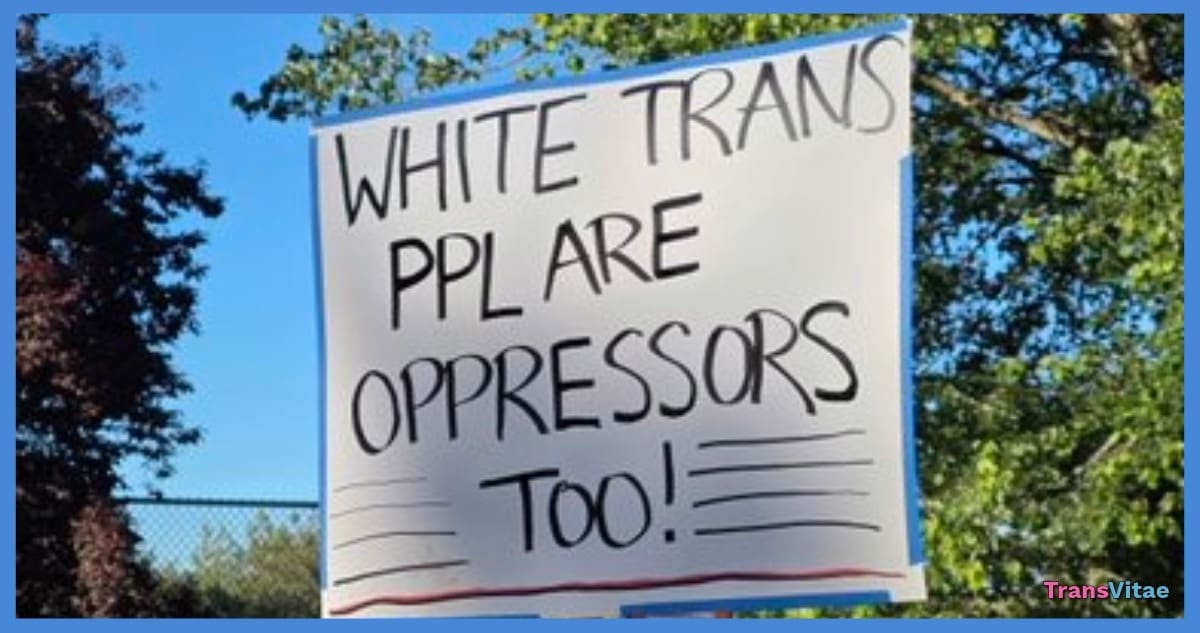
One of the fastest ways to start an argument online is to post a sign that reads, “White trans people are oppressors too.”
Within minutes, you’ll have people insisting the statement is racist. Others will call it obvious. Some will argue that being transgender erases privilege altogether. Others will insist that race always comes first. Before long, everyone is talking past one another.
That is exactly what has happened over the past week as discussion surrounding intersectionality has erupted once again across transgender social media.
The unfortunate reality is that many of these conversations begin with assumptions instead of definitions. People hear words like “privilege,” “oppressor,” or “intersectionality” and immediately substitute whatever meaning they’ve picked up from years of internet discourse. The result is predictable. Instead of learning from one another, we end up defending positions we haven’t even stopped to define.
The transgender community has enough battles being fought against it from the outside. We don’t need to create more confusion within our own ranks by misunderstanding one of the most important ideas in modern social justice.
Intersectionality Is About Context, Not Competition
Intersectionality was introduced by legal scholar Kimberlé Crenshaw to explain why people can experience discrimination in ways that cannot be understood by looking at only one aspect of their identity.
A Black woman doesn’t simply experience racism plus sexism as two separate issues. Those experiences overlap and create unique challenges that neither category alone fully explains.
The same principle applies throughout the transgender community.
A white transgender woman and a Black transgender woman are both transgender. Both may experience gender dysphoria, discrimination, housing insecurity, employment bias, or harassment.
Yet their lives are not identical.
One may also experience racial profiling, disparities in healthcare, higher rates of police violence, or generational economic inequality. Those aren’t “extra oppression points.” They are additional realities that shape daily life.
Intersectionality asks us to recognize those differences rather than pretend everyone’s experiences are interchangeable.
Being Marginalized in One Way Doesn’t Erase Privilege in Another
This is the point where many people become uncomfortable.
There is a tendency to think privilege works like a bank account. If you experience discrimination because you’re transgender, then your privilege balance should automatically drop to zero.
That isn’t how privilege works. Privilege isn’t about having an easy life. It’s about barriers you don’t have to face.
- A white transgender woman may never worry about racial profiling.
- A wealthy transgender woman may have access to surgeries that someone living below the poverty line could never afford.
- An able-bodied transgender person may never have to navigate inaccessible healthcare facilities.
- A transgender citizen may never experience the fear of immigration enforcement.
Each person faces genuine hardship. Each may also possess advantages that someone else in the community does not. Both statements can be true simultaneously.
The Word “Oppressor” Is Where Everything Falls Apart
The sign in the photo uses the word oppressors, and that word carries tremendous emotional weight. Many people hear it as a personal accusation.
“You are intentionally harming me.”
That isn’t always how people using the term mean it. In discussions of systems and institutions, someone can benefit from structures that disadvantage others without consciously choosing those structures.
For example, a white transgender woman can absolutely experience anti-trans discrimination while also benefiting from racial privilege in interactions with employers, landlords, police officers, doctors, or judges.
Recognizing that reality isn’t the same as calling someone evil. It also doesn’t mean every white trans person behaves the same way. Where internet discourse often fails is by collapsing structural conversations into personal moral judgments. That’s how nuanced discussions become shouting matches.
The Internet Rewards Absolutes
Social media is an awful place for discussing complicated ideas. A sentence that begins, “In certain institutional contexts…” receives almost no engagement.
A sign with six words goes viral. Algorithms reward certainty. Nuance disappears.
Soon, people are arguing against caricatures instead of ideas. One side believes everyone is being labeled an oppressor. The other believes acknowledging any privilege somehow minimizes transgender oppression.
Neither conclusion follows from intersectionality itself.
Listening Doesn’t Mean Ranking Suffering
Perhaps the biggest misconception surrounding intersectionality is that it’s about deciding who has it worse. It isn’t.
The goal isn’t to build a hierarchy of suffering. No one wins because their life has been more difficult. Instead, intersectionality asks us to listen before assuming our own experience represents everyone else’s.
That matters within transgender spaces. The healthcare concerns of a disabled trans woman may differ dramatically from those of an athletic twenty-year-old. An older transgender woman transitioning after retirement has different obstacles than someone transitioning in high school. A Native American trans man living on tribal land may have different experiences than someone living in downtown Seattle.
Recognizing those differences doesn’t divide the community. Ignoring them does.
Why This Conversation Feels So Personal
Many white transgender people spent years hiding who they were. They’ve experienced rejection by family. Employment discrimination. Housing instability. Violence. Depression. Suicidal thoughts.
When someone says they still possess privilege, it can feel like those experiences are being dismissed. That emotional response is understandable.
But acknowledging privilege isn’t the same as denying suffering. A person can survive cancer and still benefit from being wealthy. Someone can grow up poor and still benefit from being able-bodied. A transgender person can experience discrimination while also benefiting from whiteness, citizenship, education, or financial stability.
Life is rarely either-or. It is almost always both-and.
The Danger of Assuming Your Story Is Universal
One of the healthiest things any community can do is admit that no single experience represents everyone.
That includes white trans women. That includes Black trans women. That includes trans men. That includes nonbinary people. None of us experiences the world exactly the same way.
When we assume otherwise, we unintentionally erase people whose lives don’t resemble our own. Intersectionality exists to correct that blind spot.
Building a Stronger Community
The transgender community is under extraordinary political pressure.
Healthcare restrictions continue. Legal protections remain under attack. Employment discrimination persists. Violence remains disproportionately high.
Those external challenges make internal conversations even more important. If intersectionality becomes another buzzword people use to attack one another, we’ve missed the point entirely.
Instead, it should encourage curiosity. Ask questions. Listen to experiences that differ from your own. Accept that two people can both be telling the truth about their lives even when those truths aren’t identical.
The goal isn’t agreement on every issue. The goal is understanding.
The Bottom Line
The sign that sparked the latest online debate was never going to fit the full complexity of intersectionality onto a piece of poster board.
Whether you agreed with its wording or hated it, it succeeded in one respect: it forced people to confront uncomfortable questions about identity, privilege, and community.
Being transgender is a profound part of who many of us are. It shapes how we move through the world, how we’re treated, and the challenges we face.
But it isn’t the only part. Our race, disability status, income, age, immigration status, religion, sexuality, and countless other factors shape our lives as well.
Intersectionality doesn’t ask us to compete over who suffers most. It asks us to recognize that none of us experiences life through a single lens.
When we understand that, we’re far more likely to build a transgender community rooted in empathy instead of assumption and solidarity instead of slogans.
