


I want to be upfront: I know this piece will make some people uncomfortable. I know I may lose readers. I know some people will feel disappointed, confused, or even hurt by what I’m about to say.
I’m not writing this to provoke outrage. I’m writing it because I’m tired of pretending that certain conversations don’t exist just because they’re difficult.
I’m a transgender woman. I began medical transition three years ago. I live openly. I don’t regret transitioning. It made my life livable in ways I didn’t know were possible. But I’m also not comfortable repeating phrases that don’t feel honest to my lived reality. One of those phrases is “transgender women are women.”
For many people, that sentence is affirming and grounding. I understand why. I respect that. For me, it feels incomplete. It feels like a slogan standing in for something far more complicated.
Biologically, I am male. I experience gender dysphoria. Transitioning helps treat that dysphoria. It helps me function, breathe, and exist more comfortably in my body. But it does not erase my biology, my history, or how strangers perceive me.
Saying that out loud feels risky. But honesty usually is.
Living In The Space Between Identity And Perception
Gender dysphoria isn’t an ideology. It isn’t a belief system. It’s a condition that creates persistent distress when your internal sense of self doesn’t align with your physical sex.
Medical transition treats that distress. It does not rewrite chromosomes. It does not undo decades of socialization. And it does not automatically change how the world reads you.
I live in that in-between space every day.
I don’t pass. Not consistently. Some days people read me as a woman. Some days they don’t. Some days people hesitate, stare, or seem unsure how to categorize me. That hesitation matters.
Research consistently shows that perceived gender nonconformity increases the likelihood of harassment and confrontation, especially in gendered spaces like restrooms. Studies of transgender adults in the U.S. have found that between 6 and 12 percent report being verbally harassed, physically assaulted, or sexually assaulted in a restroom within a single year, and far more report avoiding restrooms entirely out of fear.
Those numbers aren’t abstract to me. They explain why so many of us plan our days around bathroom access, hydration, and escape routes.
Why Bathrooms Became The Line For Me
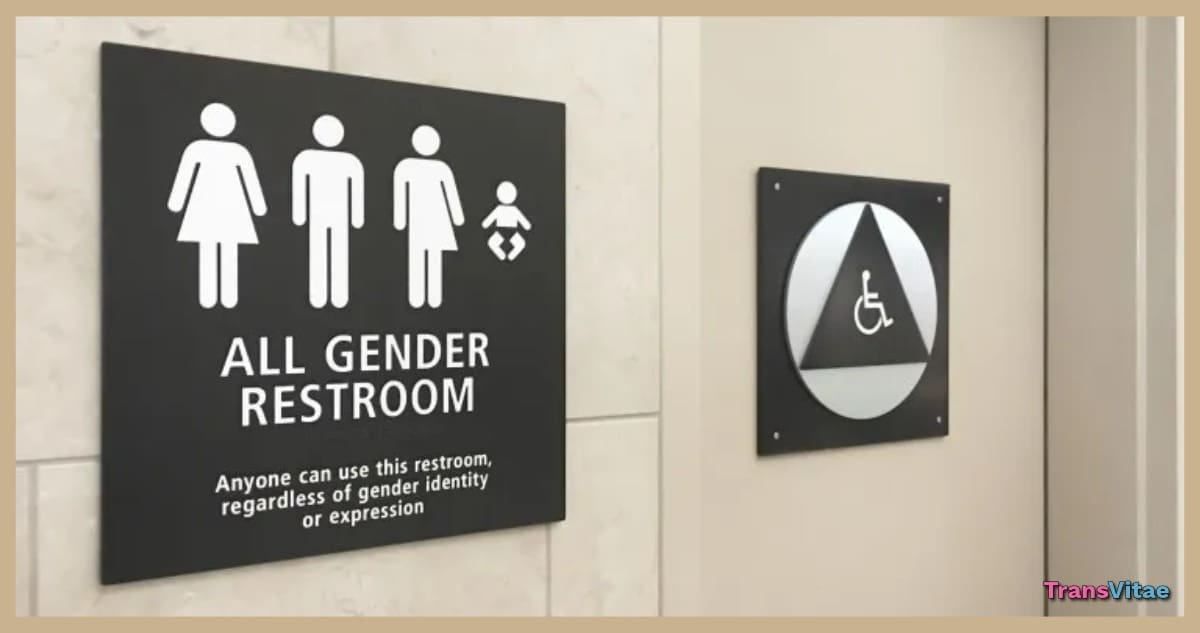
Public bathrooms are where this tension becomes impossible to ignore. Here’s my truth: I do not use women’s restrooms. I do not use women’s changing rooms. Not because I believe trans women should be excluded. Not because I think I don’t “count.” And certainly not because I agree with the political fear narratives around bathrooms.
I don’t use them because I am deeply aware of how I am perceived.
Bathrooms are intimate spaces. People are vulnerable there. They’re not thinking about policy or inclusion statements. They’re thinking about safety, privacy, and getting out quickly.
When I imagine myself entering a women’s restroom while being perceived as male, I don’t feel empowered. I feel anxious. I imagine a woman pausing. A mother pulling her daughter closer. A teenager suddenly unsure if she’s safe.
That discomfort matters to me.
And the data tells us something important here: fear and confrontation in bathrooms overwhelmingly flow toward transgender people, not from them, but perception is what triggers those moments. The person who looks “out of place” becomes the target of scrutiny, whether they intend harm or not.
I don’t want to be the person who creates that moment of fear, even unintentionally, when I have another option available.
Feminism, Parenthood, And Listening To Discomfort
I’m a staunch feminist. That didn’t disappear when I transitioned. I’m also the parent of three daughters, and that reality shapes this conversation in ways I can’t separate from myself.
Feminism taught me to take women’s discomfort seriously, not selectively. It taught me that women’s safety concerns have historically been dismissed as hysteria or overreaction, often with devastating consequences.
When I look at bathrooms and changing rooms, I don’t see a debate stage. I see my daughters. I see their friends. I see spaces that exist precisely because women have been vulnerable there.
Women’s fear doesn’t need to be malicious to be real.
I don’t believe honoring that fear means denying my identity. I believe it means being honest about context and perception.
Passing Is Uncomfortable To Talk About, But It’s Central
Passing is one of the most uncomfortable topics in trans spaces, and I understand why. It can feel like reinforcing oppressive standards or suggesting that acceptance is conditional.
But here’s the reality: the world responds to perceived gender, not internal identity.
I have trans women friends who pass completely. They are read as women everywhere they go. Their presence in women’s spaces does not raise alarms because no one perceives them as male.
Telling those women to use men’s restrooms would be dangerous. Data consistently shows that trans women who are perceived as female face increased risk of harassment and assault when forced into men’s spaces.
Their safety calculation is different from mine. Pretending those differences don’t exist doesn’t make us safer. It just makes us quieter.
The Data Everyone Ignores
Here’s something that rarely gets discussed honestly: restrictive bathroom policies do not reduce violence, and inclusive policies do not increase it.
Large-scale reviews of cities and states with trans-inclusive bathroom laws show no increase in sexual assaults or public safety incidents linked to those policies. That myth simply isn’t supported by evidence.
At the same time, data consistently shows that transgender people themselves are at far greater risk of harassment, assault, and violence in bathrooms, regardless of which restroom they use.
That tells me something important: this issue is not about predators. It’s about perception, fear, and vulnerability colliding in spaces that weren’t designed for nuance.
My choice is not about endorsing fear. It’s about navigating it responsibly until the world catches up.
Why Slogans Fall Short For Me
“Trans women are women” is often treated as a moral absolute. A line you must repeat to prove you belong. For some people, it’s grounding. For me, it feels like a flattening of reality.
I don’t experience my womanhood as identical to cis womanhood. That doesn’t make it fake. It makes it different.
Data doesn’t contradict that. It reinforces it. Trans women face unique patterns of violence, medical discrimination, and social scrutiny that cis women do not experience in the same way.
Pretending those differences don’t exist doesn’t protect us. It makes trust harder to build, especially in a political climate already hostile to nuance.
I Don’t Believe In Forced Acceptance In Vulnerable Spaces
There’s a belief in some progressive circles that discomfort must be endured for justice to occur. That people should simply adjust. That idea collapses in spaces where people are naked, exposed, or afraid.
I don’t want my existence to be a lesson someone is forced to learn while they’re vulnerable.
Acceptance built on coercion is brittle. We can see that in the backlash, the legislation, and the moral panic playing out across the country right now. I want acceptance built on familiarity, trust, and time.
The Irony Still Matters
The cruel irony is that transgender women are far more likely to be harmed in bathrooms than to harm anyone else.
Studies consistently show that trans adults are several times more likely than cisgender adults to experience violent victimization overall. Bathrooms are just one of many public spaces where that risk shows up.
My choice doesn’t deny that reality. It responds to it. This is not a perfect solution. It’s a personal one, shaped by how I am perceived and what I believe minimizes harm.
This Isn’t A Policy Argument
I’m not advocating for bans. I’m not endorsing exclusionary laws. I’m not telling other trans women what they should do.
I’m explaining how I navigate a world where perception matters, where data shows risk flows toward us, and where my own presentation creates specific ethical questions I refuse to ignore. There is room for different answers.
One of my deepest fears right now is how quickly disagreement inside trans spaces gets framed as betrayal. We cannot build a resilient movement if honesty is treated as treason.
If we want society to trust us, we have to show we can grapple with complexity without collapsing into slogans or silencing each other. This conversation is hard because it forces us to sit with vulnerability, fear, and reality at the same time. Avoiding it hasn’t helped.
The Bottom Line
Acknowledging my biology doesn’t erase my dysphoria. Acknowledging that I don’t pass doesn’t mean I’ve given up. Acknowledging women’s discomfort doesn’t invalidate my own.
This isn’t self-erasure. It’s situational awareness. I don’t expect everyone to agree with me.
I hope people can see that this position comes from care, not contempt. From feminism, not fear. From lived experience, supported by data, not ideology. We are navigating a world that was not built for us. We will not all take the same path through it.
That doesn’t weaken us. It makes us human.
