


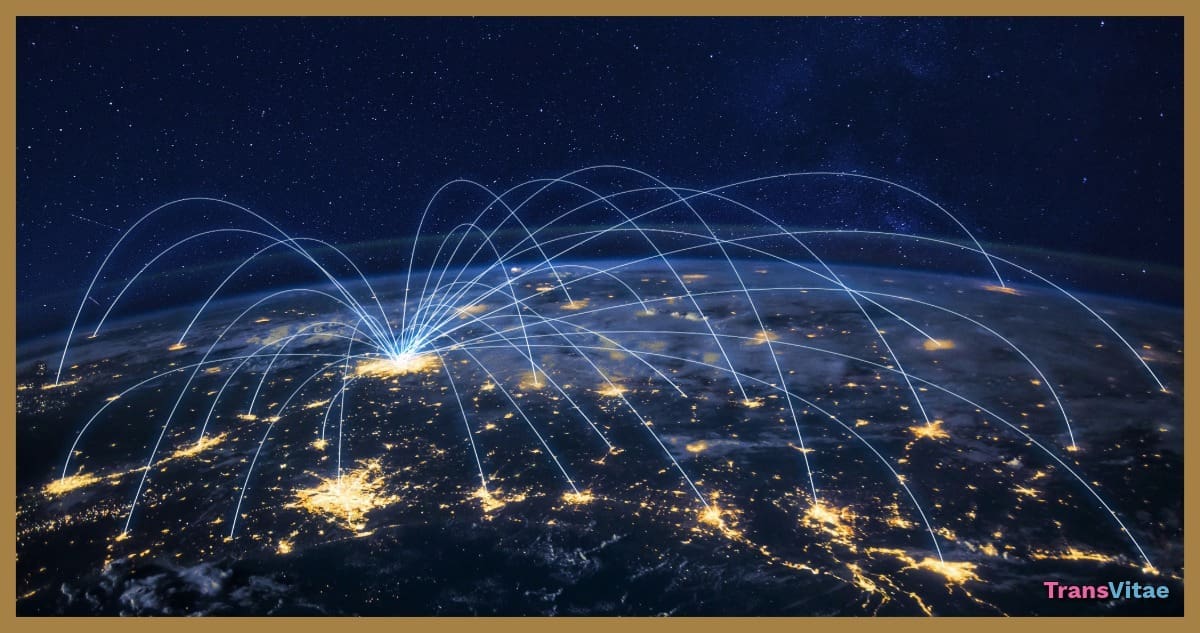
Something dangerous is happening, and it’s not staying contained within borders.
When a country rolls back protections for transgender people, it doesn’t just affect the people living there. It becomes a talking point, a political weapon, and a blueprint. It gets repackaged, exported, and dropped into U.S. debates like it belongs here.
And suddenly, it does.
If you’ve been watching the news lately, you’ve probably noticed a pattern. Policies restricting transgender healthcare, limiting legal recognition, or redefining gender identity aren’t popping up randomly. They echo each other. They borrow language. They share strategy.
This is not coincidence. It’s a feedback loop.
And if we don’t understand how it works, we’re always going to be reacting instead of staying ahead of it.
The Global Echo Chamber of Anti-Trans Policy
Let’s be real. Lawmakers don’t operate in a vacuum anymore.
When a government somewhere in the world pushes through a restrictive transgender policy, it gets picked up instantly by international media, think tanks, and political influencers. Within days, sometimes hours, those ideas are reframed as “proof” that similar policies are reasonable, necessary, or even inevitable.
You’ll hear phrases like:
“This country is doing it.”
“Other nations are reconsidering.”
“We’re just aligning with global standards.”
That last one is doing a lot of heavy lifting.
Because the truth is, there is no single “global standard” for transgender rights. What exists instead is a patchwork of policies, shaped by culture, politics, religion, and power. But when one country moves backward, it gives cover for others to do the same.
It creates legitimacy where there shouldn’t be any.
Policy Tourism: Yes, It’s a Thing
There’s a quiet practice happening behind the scenes that doesn’t get talked about enough: policy tourism.
Lawmakers, advocacy groups, and political strategists study legislation from other countries and bring those ideas home. Sometimes they copy language directly. Sometimes they tweak it to fit local laws. But the structure, the intent, and the messaging stay the same.
We’ve seen this play out in real time.
Restrictions on gender-affirming care in one country quickly show up in talking points in U.S. state legislatures. Debates about “protecting children” follow nearly identical scripts. Even the phrasing of bills can feel eerily familiar.
It’s not organic. It’s coordinated.
And it works because it creates the illusion that these ideas are widespread and accepted.
The Power of “International Precedent”
Here’s where things get especially tricky.
In U.S. legal and political arguments, international precedent can be used as a rhetorical tool. Not because it’s binding, but because it sounds persuasive.
If lawmakers can point to another country and say, “Look, they’ve already done this,” it lowers resistance. It makes controversial policies seem less extreme.
Even when the comparison doesn’t hold up.
A policy implemented in a completely different legal system, with different healthcare infrastructure and cultural context, gets treated as if it’s directly transferable.
It’s like copying someone else’s homework without realizing you’re in a different class.
And yet, it still influences public opinion.
Media Amplification: The Narrative Machine
Let’s talk about how these policies spread so fast.
Media coverage plays a huge role, especially when it’s framed in a way that reinforces fear or controversy. Headlines often simplify complex legal changes into bite-sized narratives that can be easily shared, debated, and, let’s be honest, weaponized.
A restrictive policy overseas becomes:
“A growing global concern.”
“A shift in how countries view gender identity.”
“A response to rising debates.”
Notice how neutral that sounds?
That framing matters. It strips away the harm and replaces it with a sense of inevitability. It tells audiences, consciously or not, that change is happening everywhere and that resistance might be futile.
And once that narrative takes hold, it’s incredibly hard to undo.
Think Tanks and the Pipeline of Ideas
Behind many of these policy shifts are well-funded organizations that operate across borders.
Think tanks, advocacy groups, and political networks share research, draft legislation, and coordinate messaging. They publish reports that get cited internationally, even when those reports are deeply flawed or selectively interpreted.
A study conducted in one country can suddenly appear in U.S. hearings as evidence. A legal argument made overseas can be repackaged for American courts.
This creates a pipeline of ideas that flows continuously, reinforcing the same narratives in different places.
It’s not just about passing laws. It’s about shaping the conversation.
Cultural Influence and Public Perception
Policy doesn’t exist in isolation. It shapes culture, and culture shapes policy.
When people in the United States hear that another country is restricting transgender rights, it can influence how they think about the issue, even if they don’t realize it.
For some, it creates doubt:
“If they’re reconsidering this, maybe there’s a reason.”
For others, it reinforces bias:
“See, even they don’t agree with it.”
And for those already opposed to transgender rights, it provides validation. This shift in public perception is often the real goal. Laws follow culture, not the other way around.
Change the narrative, and the policies become easier to pass.
The Slippery Slope of Medical Gatekeeping
One of the most common threads we’re seeing globally is the push toward increased medical gatekeeping.
Instead of allowing individuals to define their own identities, governments are inserting layers of approval. Medical boards. Psychological evaluations. Documentation requirements.
On the surface, it’s framed as “ensuring accuracy” or “protecting people.”
In reality, it creates barriers.
And once those barriers exist somewhere, they become a model.
U.S. lawmakers can point to these systems and argue for similar structures, even if they contradict established medical standards here. It shifts the baseline of what’s considered acceptable.
What was once unthinkable becomes debatable. What was debatable becomes policy.
Data, or the Illusion of It
Another tactic that travels well across borders is the selective use of data.
Statistics from one country are often used to justify policies in another, even when the contexts are completely different. Healthcare systems, reporting methods, and population demographics all vary widely.
But nuance doesn’t make headlines. So numbers get simplified, stripped of context, and presented as universal truths. It’s the kind of thing that sounds convincing in a debate but falls apart under scrutiny.
The problem is, by the time it’s scrutinized, the narrative has already spread.
Legal Ripple Effects
Even though U.S. courts are not bound by foreign laws, international developments can still influence legal arguments.
Attorneys may reference overseas policies to support claims about societal norms or evolving standards. Judges, consciously or not, are aware of global trends.
And in a legal system that often looks at precedent and interpretation, those trends can matter.
Especially in cases involving civil rights.
If enough countries move in a certain direction, it can create pressure, subtle but real, on how similar issues are viewed domestically.
What This Means for Trans People in the U.S.
So what does all of this actually look like on the ground?
It looks like familiar arguments showing up in new places.
It looks like legislation that feels copy-pasted.
It looks like debates that seem to restart every time another country makes a move.
It also looks like increased uncertainty.
Because when rights are framed as something that can be reconsidered anywhere, they start to feel less stable everywhere.
For transgender people, that instability isn’t abstract. It affects access to healthcare, legal recognition, employment protections, and personal safety.
It’s not just about what happens overseas. It’s about how quickly it can show up here.
The Other Side of the Coin: Progress Travels Too
Now, here’s the part that doesn’t get enough attention. Progress also spreads.
When countries expand protections, improve healthcare access, or adopt inclusive policies, those changes can influence global conversations in positive ways.
They provide examples of what’s possible. They offer evidence that inclusion works. They create pressure in the opposite direction.
The problem right now is that negative developments often move faster and get more attention. Outrage travels quickly. Fear spreads easily. But progress still matters, and it still has power.
Staying Informed Without Burning Out
Let’s be honest. Keeping up with global policy shifts can feel overwhelming. There’s always another headline. Another bill. Another debate.
And it’s easy to feel like everything is connected in the worst possible way. But understanding these patterns isn’t about doomscrolling. It’s about awareness.
When you recognize how ideas move, you can spot them earlier. You can call them out. You can push back before they gain traction.
It turns reaction into strategy.
What Can Be Done
This is the part where a lot of articles throw a checklist at you. We’re not doing that.
Instead, think of this as a mindset shift.
- Pay attention to where arguments are coming from.
- Question claims about “global trends.”
- Look beyond headlines and into context.
- Support organizations that track and challenge these narratives.
And maybe most importantly, don’t let anyone convince you that regression somewhere else makes it inevitable here. Because it doesn’t.
The Bottom Line
Here’s the reality. Policies don’t stay put. Ideas don’t respect borders. Narratives don’t need passports. What happens in one country can and does shape what happens in another. But influence goes both ways.
The same way harmful policies can spread, so can resistance. So can advocacy. So can truth.
And if there’s one thing history has shown, it’s that rights are never just given or taken in one place at a time. They’re fought for everywhere, all at once.
