


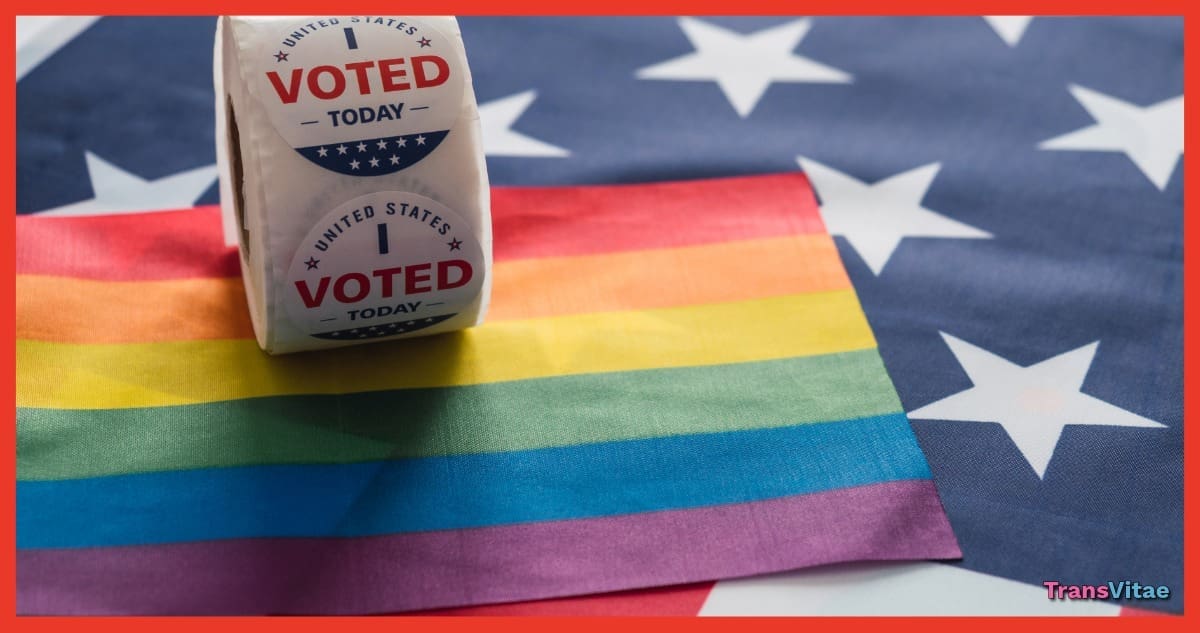
Today, millions of Americans are heading to the polls to decide who will represent them in Congress, state legislatures, and local governments. In several states, voters are also being asked to decide questions that directly affect the rights and everyday lives of transgender people.
For most Americans, Election Day is an opportunity to exercise their democratic rights. For transgender Americans, it can also mean watching strangers decide what protections they should have, which healthcare they can access, and whether transgender children should be allowed to participate in school activities alongside their classmates.
There is something deeply uncomfortable about that arrangement. We are constantly reminded that America is a democracy, where the majority gets to decide. But that explanation leaves out an essential part of the American constitutional system.
Democracy is supposed to give people a voice in government, not unlimited authority over the rights of their neighbors.
And that distinction matters when the rights of a small, politically vulnerable minority become the subject of a statewide popularity contest.
Democracy Was Never Supposed to Mean Unlimited Majority Rule
Americans are taught from childhood that democracy means the majority rules. That is broadly true when selecting representatives or deciding ordinary questions of public policy. However, the United States is also a constitutional republic, with legal protections designed to limit what governments can do, even when their actions are popular.
The Bill of Rights exists precisely because certain freedoms should not depend entirely on the preferences of whichever political faction happens to hold power.
Freedom of religion, freedom of speech, due process, and equal protection are not supposed to disappear because a majority finds a particular group unpopular.
The Supreme Court addressed this principle in West Virginia State Board of Education v. Barnette in 1943. In a case involving students who refused to salute the American flag, the Court explained that fundamental rights cannot simply be submitted to a vote.
That principle is particularly important for minority populations.
If constitutional protections only applied when a majority approved of the people exercising them, they would offer little protection when they were needed most.
Of course, not every disagreement over transgender policy involves an established constitutional right. Courts continue to debate how constitutional protections apply to specific questions involving healthcare, education, athletics, and sex classifications.
But that legal complexity does not eliminate the underlying democratic concern: should the popularity of a minority group determine how government treats its members?
Transgender Rights Are on the Ballot in 2026
This year’s midterm elections provide several examples of how transgender-related policies have moved beyond legislative debates and into statewide ballot campaigns.
In states including Arizona, Colorado, Missouri, Nebraska, and Washington, voters are confronting measures involving transgender athletes, gender-affirming healthcare, or legal definitions of sex.
The proposals differ substantially. Some address eligibility for school sports, while others concern medical treatment or broader constitutional language. Their specific provisions and legal consequences deserve individual scrutiny rather than being treated as interchangeable.
Still, they share an important characteristic. They ask the general electorate to establish rules that disproportionately affect a relatively small population.
Consider transgender students who simply want to participate in school athletics.
Their opportunities may depend on the outcome of campaigns in which they have little political influence, particularly when many affected students are too young to vote.
Meanwhile, campaign advertisements can reduce complicated questions involving fairness, privacy, safety, and inclusion to slogans designed to persuade voters in a matter of seconds.
There are legitimate policy questions surrounding competitive athletics and medical care. Those questions deserve careful examination, including relevant scientific evidence, medical expertise, and the experiences of affected individuals.
But a ballot campaign is not necessarily an environment that rewards nuance. It rewards messages that motivate people to vote. And when a small minority becomes the focus of emotionally charged messaging, that creates an obvious imbalance.
America’s History Offers Some Uncomfortable Lessons
The United States has a long history of using democratic processes to restrict minority rights.
During the civil rights era, racial segregation enjoyed considerable political support in parts of the country. State governments defended discriminatory systems as expressions of local authority and public preference.
Those systems did not become just because they were popular.
The Supreme Court’s 1954 decision in Brown v. Board of Education established that racial segregation in public schools violated the Equal Protection Clause of the Fourteenth Amendment.
The decision demonstrated why constitutional review matters when political majorities support unequal treatment.
More recently, same-sex marriage became the subject of numerous statewide ballot measures.
In 2008, California voters approved Proposition 8, which eliminated the state constitutional right of same-sex couples to marry. The measure was later invalidated through federal litigation.
In 2015, the Supreme Court’s decision in Obergefell v. Hodges recognized a constitutional right to marriage for same-sex couples nationwide.
These historical examples are not legally identical to today’s disputes involving transgender people. Different laws, constitutional provisions, and government interests are involved.
Nevertheless, they illustrate a recurring tension in American democracy.
Majorities can support restrictions that courts subsequently determine violate constitutional protections.
History also shows that public opinion can change dramatically. Rights that once faced widespread opposition may eventually become accepted parts of American life.
That raises an uncomfortable question: how many people should have to endure discriminatory treatment while society decides whether they deserve equal consideration?
Ballot Measures Can Turn People Into Political Campaign Material
One of the most troubling aspects of putting minority rights on the ballot is what happens during the campaign itself.
Transgender people stop being neighbors, coworkers, students, and family members. Instead, they become the subject of advertisements, political mailers, televised debates, and social media campaigns.
Their lives are presented as problems that voters must solve.
The language often emphasizes protecting children, preserving fairness, or defending traditional values. Supporters of restrictive measures may sincerely believe those policies serve important public interests.
But sincerity does not eliminate the obligation to examine whether the proposed restrictions are necessary, proportionate, and supported by evidence.
Nor does it erase the effect that repeated negative messaging can have on the people being discussed.
Imagine being a transgender teenager watching television advertisements suggesting that students like you represent a threat to other children.
Imagine hearing adults debate whether you should be allowed to join a school team while your classmates discuss the issue as though your participation were an abstract political question.
For the voters, the campaign might end when the polls close.
For the people affected, its consequences can continue in classrooms, workplaces, medical offices, and communities long afterward.
That is a cost political campaigns rarely acknowledge.
A Popular Law Is Not Necessarily a Constitutional One
There is another distinction that frequently gets lost in debates over ballot initiatives: voter approval does not automatically make a law constitutional.
A measure can win overwhelming public support and still violate federal constitutional protections. Courts can review voter-approved laws just as they review legislation passed by elected representatives.
However, that protection has limits. Courts do not invalidate laws simply because they are unfair, controversial, or harmful. Plaintiffs must establish a legal basis for challenging them, and judicial interpretations of constitutional rights can change.
In United States v. Skrmetti, decided in 2025, the Supreme Court upheld Tennessee’s restrictions on certain medical treatments for transgender minors against an equal protection challenge. The ruling demonstrates that constitutional review does not guarantee transgender plaintiffs will prevail.
That reality makes the political process particularly consequential.
When restrictions are written into state constitutions, reversing them may require another constitutional amendment rather than an ordinary legislative vote. Nebraska’s proposed sports amendment and Missouri’s healthcare restrictions illustrate how ballot measures can make existing policies harder to change.
For transgender residents, the consequences may extend well beyond a single election cycle.
Protecting Minority Rights Is Part of Democracy
None of this means voters should be excluded from decisions about public policy. Ballot initiatives can serve important democratic purposes, including allowing citizens to challenge entrenched political interests and expand civil rights.
Indeed, some states are voting on measures intended to strengthen equality protections. Vermont voters are considering an amendment that would explicitly protect people from discrimination based on characteristics, including gender identity and gender expression.
The issue is not whether direct democracy is inherently good or bad. It is whether the political process adequately respects the rights and interests of people who lack the numbers to protect themselves at the ballot box.
That requires more than counting votes. It requires examining evidence, considering constitutional limitations, listening to affected communities, and resisting campaigns that portray vulnerable populations as threats.
Transgender Americans are not asking to be exempt from democratic government. They are asking to participate in society without having their basic dignity continually subjected to political contests.
Today, voters in several states will make decisions that could reshape the lives of transgender residents, including children who cannot cast ballots themselves.
Tomorrow, the campaign advertisements will disappear, political consultants will move on, and candidates will begin discussing the next election.
But transgender people will still be here, living with whatever decisions were made about us.
The measure of a democracy is not simply whether the majority gets its way. It is also how that democracy treats the people who cannot win a popularity contest.
