


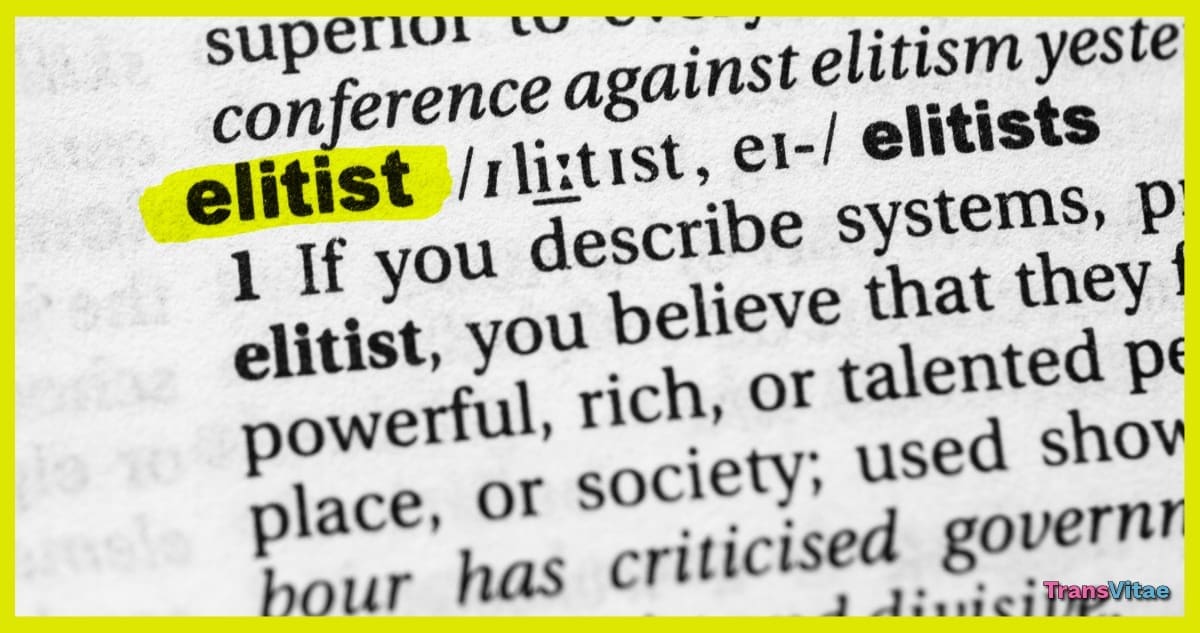
J.K. Rowling has apparently discovered a new enemy in her ongoing crusade against transgender inclusion: elitism. Yes, the billionaire author of the Harry Potter franchise, a woman with enough money to finance legal challenges, establish organizations, and influence national political conversations, has decided that transgender activism is somehow the movement of the privileged.
You really cannot make this stuff up.
In her latest comments revisiting the controversy surrounding her 2020 essay on sex and gender, Rowling characterized transgender activism as elitist, suggesting that wealthy supporters of transgender rights are insulated from the consequences of the policies they promote. Her argument is that affluent women can advocate for inclusive bathrooms, changing rooms, and other facilities without having to share the same spaces themselves.
There is a legitimate discussion to be had about whether wealthy people understand the everyday experiences of working-class communities. Economic privilege can absolutely distort someone’s perspective. But when that criticism comes from one of the world’s wealthiest authors, who is actively financing legal battles over how transgender people are permitted to participate in society, the hypocrisy deserves considerably more attention.
Because if we are going to talk about privilege, perhaps we should start with the person holding the checkbook.
The Billionaire Who Thinks Everyone Else Is Elitist
Rowling’s argument relies heavily on the idea that wealthy transgender rights supporters are disconnected from ordinary women. She suggests that people with access to private bathrooms, exclusive facilities, and personal security have little understanding of the concerns facing women who depend on public accommodations.
Fair enough. Wealth can create enormous distance between someone and the daily realities of ordinary people.
But Rowling herself occupies precisely the kind of privileged position she criticizes.
She does not have to worry about losing her job because a customer complains about her gender identity. She does not have to calculate whether using a public restroom might result in harassment. She does not have to wonder whether a landlord will reject her application because her identification documents do not match someone’s expectations.
And she certainly does not have to choose between paying rent and financing a lawsuit.
Transgender people, particularly those living paycheck to paycheck, frequently face exactly these kinds of challenges. Yet Rowling presents transgender advocacy as though it primarily represents the interests of wealthy celebrities and powerful institutions.
That framing conveniently erases the ordinary transgender people whose lives are directly affected by the policies she opposes.
The transgender cashier, teacher, nurse, construction worker, or college student asking to use a restroom without confrontation is not exercising elite privilege.
They are trying to get through Tuesday.
When Billionaires Become the Grassroots Resistance
Rowling’s financial involvement makes her criticism of elitism particularly difficult to reconcile.
Through the J.K. Rowling Women’s Fund, the author has committed resources to supporting legal cases involving sex-based rights. She has also supported organizations challenging policies that recognize transgender women in certain female-designated spaces.
There is nothing inherently improper about using personal wealth to support legal causes. People finance litigation, donate to advocacy organizations, and contribute to political campaigns all the time.
But let’s acknowledge what that represents.
A billionaire financing litigation to influence public policy is exercising extraordinary economic and political power.
That is not the same thing as a working-class woman expressing concern about privacy in a changing room. It is not equivalent to an ordinary citizen contacting an elected representative.
Rowling possesses the resources to turn her personal political convictions into organized legal action with potentially nationwide consequences.
Meanwhile, many transgender people affected by those challenges lack the financial resources to defend themselves individually, much less influence the broader legal landscape.
Calling their advocacy elitist while using immense personal wealth to restrict their access to public life is a remarkable inversion of who actually holds power.
Apparently, privilege only counts when someone else has it.
The Working-Class Women Missing From Her Argument
Another problem with Rowling’s position is the assumption that working-class women share a unified perspective on transgender inclusion.
They do not.
Some women oppose allowing transgender women into female-designated facilities. Others support inclusion. Still others have concerns about privacy but do not believe excluding transgender people is the appropriate solution.
Working-class women are not a political monolith, and neither are transgender people.
In fact, transgender women can also be working-class women. They work in restaurants, hospitals, retail stores, factories, schools, and countless other workplaces. They struggle with childcare costs, healthcare bills, rising rents, and stagnant wages.
The distinction matters because Rowling’s argument often positions transgender inclusion as something wealthy outsiders impose upon ordinary women.
That framing leaves little room for transgender women who are themselves economically vulnerable.
It also overlooks transgender men and nonbinary people whose access to public facilities can become complicated by policies based strictly on sex assigned at birth.
A transgender man who has lived as male for decades may be required under certain restrictive policies to use a women’s restroom. That outcome can create discomfort and potential safety concerns for everyone involved.
Real-world experiences are considerably messier than political slogans suggest.
Protecting Women Should Include Transgender Women
Rowling frequently frames her advocacy as a defense of vulnerable women, particularly survivors of sexual violence. Her own experiences with domestic abuse and sexual assault are serious and deserve respect.
So do the experiences of transgender survivors.
Transgender women experience sexual violence, domestic abuse, and harassment. They also need access to appropriate support services, safe housing, and healthcare.
Rowling’s Beira’s Place provides services to women based on sex, rather than gender identity. Its supporters argue that sex-specific services are important for survivors who feel uncomfortable receiving support in mixed-sex environments.
That concern should not simply be dismissed. Survivors deserve compassionate services that address their individual needs.
But acknowledging those needs does not require pretending transgender survivors have somehow stopped existing.
The question should be how to provide effective, accessible services for everyone who needs them. Instead, much of the political debate focuses on determining which women should be excluded.
A movement claiming to defend vulnerable women should be willing to confront the vulnerability of transgender women, too.
Human Rights, With a Few Convenient Exceptions
Perhaps the most revealing contradiction in Rowling’s position involves her repeated insistence that transgender people deserve human rights and protection from discrimination.
In her October essay, Rowling explicitly rejected the idea that transgender people should be stripped of their rights or denied personal safety. That distinction matters, and her position should be represented accurately.
But there is an obvious question.
What happens when the policies she supports make everyday life more difficult or potentially dangerous for transgender people?
Rowling argues that sex-based distinctions are necessary in certain settings. Her critics argue that broad exclusions can leave transgender people without safe, practical access to facilities and services.
The UK Supreme Court’s April 2025 ruling interpreted sex under the Equality Act 2010 as biological sex while preserving protections against discrimination based on gender reassignment. The ruling did not declare that transgender people could be discriminated against freely.
That legal distinction is important.
Nevertheless, the continuing political battles over implementation demonstrate why transgender advocates remain concerned about the practical consequences.
Supporting human rights in principle is relatively easy. Supporting meaningful protections when those rights become inconvenient is where the real test begins.
The Privilege of Never Facing the Consequences
Ultimately, the biggest contradiction in Rowling’s criticism of elitism is not simply that she is wealthy.
Wealthy people can advocate for legitimate causes. They can raise valid concerns about inequality, discrimination, and public policy.
The problem arises when someone with extraordinary influence portrays a marginalized population’s demands for basic participation in society as the agenda of powerful elites.
Rowling can finance litigation, influence public debate, and continue living comfortably regardless of the outcome.
The transgender people affected by those legal decisions do not have that luxury.
They must navigate the consequences in workplaces, schools, public facilities, and everyday interactions.
Rowling is entitled to express her opinions. She is entitled to support organizations and legal challenges consistent with her beliefs. And she is entitled to disagree with transgender advocates.
But transgender people are equally entitled to challenge the contradictions in her arguments.
Because when a billionaire with enormous cultural influence and the financial resources to shape legal policy accuses ordinary transgender people of representing elite interests, the criticism practically writes itself.
The woman with the castle, the fortune, and the legal fund is warning everyone about the dangers of privilege.
Meanwhile, transgender people are asking to use the bathroom without becoming a national controversy.
If that is what elitism looks like in 2026, someone might want to check the dictionary.
