


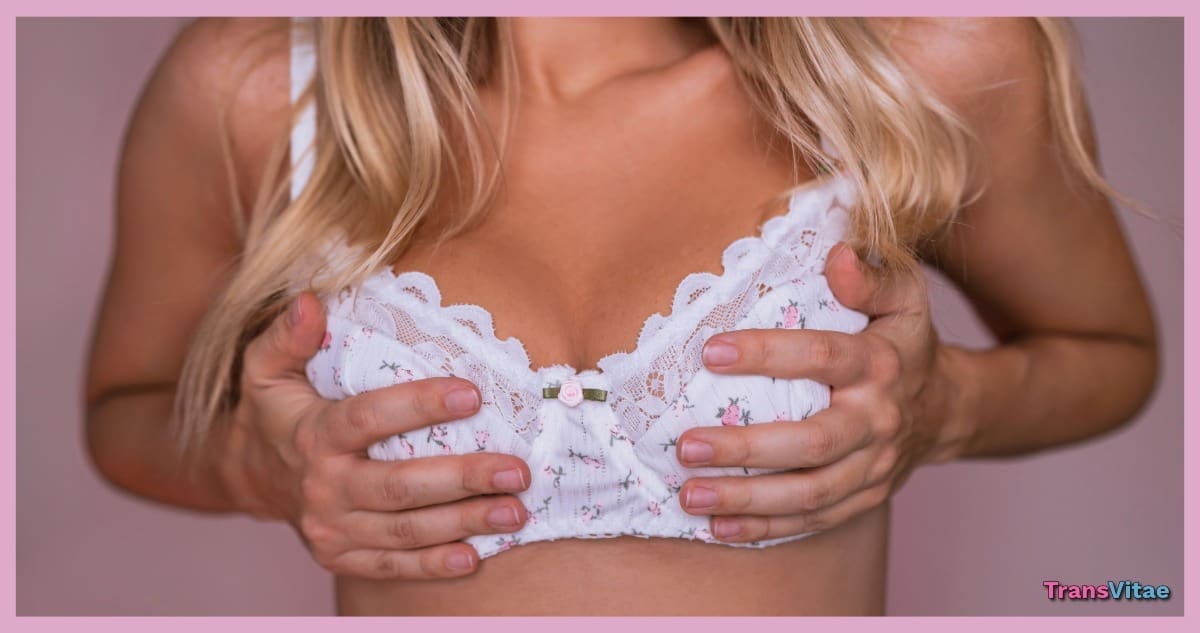
There is a particularly annoying moment that can happen when you are shopping for clothes as a trans woman. You find a top you absolutely love, maybe a plunging V-neck, a fitted sweater, a strappy camisole, or a little black dress that is practically begging to come home with you. Then you look at the model wearing it, look down at your own chest, and suddenly start wondering whether you have enough breast tissue to pull it off.
That question can hit especially hard for trans women who expected more breast development from hormone replacement therapy. After months or years of waiting for estrogen to work its magic, you may have discovered that the boobs you ordered apparently got lost somewhere in shipping.
But small breasts are not unfinished breasts. They are not failed breasts, and they certainly are not evidence that your transition somehow failed. More importantly for our purposes here, they do not disqualify you from wearing certain clothes.
Your boobs aren’t too small for that outfit. You may simply need to stop judging the outfit by whether it produces cleavage and start looking at what it actually does with the body you have.
The HRT Expectation Machine
Breast development is understandably one of the most anticipated physical changes for many people beginning feminizing hormone therapy. For someone who may have spent decades looking at a chest that never felt quite right, those first signs of development can be incredibly emotional. The tenderness starts, breast buds appear, and suddenly there is tangible evidence that your body is changing.
Then comes the waiting.
Unfortunately, social media has not exactly helped establish realistic expectations. Transition timelines can create the impression that everyone takes estrogen for a couple of years and emerges with spectacular cleavage, dramatically wider hips, flawless skin, and the ability to summon woodland creatures while getting dressed in the morning.
Real bodies are considerably less predictable.
Breast development during feminizing hormone therapy varies enormously from person to person. Genetics, age, body composition, hormone levels, individual physiology, and time can all influence the final result. Development can continue for years, and there is no dependable formula that tells someone what cup size they will eventually reach.
Some trans women develop substantial breasts. Others remain relatively small-chested. Some eventually pursue breast augmentation, while others discover that they are perfectly happy with what developed naturally. Plenty land somewhere in the middle, occasionally wishing for more while generally getting on with life.
None of those outcomes makes someone more or less feminine, and none determines which rack of clothing she is allowed to shop from.
Women’s Clothing Already Has a Body Problem
One reason small breasts can become frustrating has less to do with your chest and more to do with the way clothing is manufactured.
There is no universal female body. Cisgender women themselves have wildly different proportions. Some have large breasts and narrow hips. Others have small breasts and wide hips. Some have broad shoulders, muscular arms, long torsos, short legs, bellies, narrow waists, large rib cages, or practically no waist definition at all.
Women’s clothing nevertheless tends to be manufactured around relatively standardized proportions. That is why two women who technically wear the same size can try on the same blouse and have completely different experiences.
For trans women, those inconsistencies can become especially noticeable when shoulders, rib cage, waist, and bust do not match the proportions assumed by the garment. You might need a large because of your shoulders or rib cage, while the manufacturer apparently assumes anyone wearing that size must also possess significantly more breast tissue.
The result is a shirt that fits beautifully everywhere except the chest, where enough unused fabric remains to conceal snacks for later.
That does not mean your body failed the clothing. Sometimes the clothing simply failed your body.
Recognizing that distinction can dramatically change the experience of shopping. Instead of standing in a fitting room wondering what is wrong with your chest, you can put the shirt back on the hanger and acknowledge the much simpler reality: this particular cut was not designed for your proportions.
You Don’t Need Cleavage to Wear a Deep Neckline
One of the strangest assumptions surrounding women’s fashion is that plunging necklines require substantial breasts. In reality, smaller breasts can make low necklines easier to wear and create an entirely different aesthetic.
On a fuller chest, a deep V-neck can become dramatically cleavage-forward very quickly. On a smaller chest, that same neckline may create a long, elegant line through the torso while showing skin without revealing much breast. The result can be sleek, sophisticated, edgy, sexy, or some combination of all four.
That is not a consolation prize for not having larger breasts. It is simply another way the garment can look.
If you have avoided plunging necklines because you thought there was not enough cleavage to fill them out, try changing the question. Instead of asking whether your breasts are large enough for the neckline, ask whether you like the shape the neckline creates on your body.
Cleavage does not always have to be the objective.
Sometimes the neckline itself is the whole damn point.
Bras Are Tools, Not Construction Equipment
Bras can become another complicated area for trans women with smaller breasts. There can be an understandable temptation to view every bra as equipment whose primary job is making the chest look larger.
There is absolutely nothing wrong with enhancement. Push-up bras, padded bras, removable inserts, and breast forms exist because plenty of people enjoy changing their silhouette. Cis women have been doing it forever, so trans women certainly do not need to apologize for joining the party.
The important distinction is between wanting enhancement and believing you must enhance your chest before you are presentable.
A bra does not have to turn an A cup into something larger. Sometimes you want support. Sometimes you want a particular shape beneath a shirt. Sometimes you simply want nipple coverage. Other times, you may absolutely want your boobs pushed upward with enough enthusiasm to require FAA clearance.
All are valid choices.
For smaller breasts, bralettes can be particularly useful because many do not depend on substantial breast volume to fill rigid molded cups. Triangle bras can also work beautifully under lower-cut tops, while softer unlined bras allow the natural breast shape to determine the silhouette rather than forcing everything into a predetermined mold.
Depending on the garment and your comfort level, you may also discover one of the genuine advantages of having a smaller chest: going braless can sometimes be considerably easier.
There are perks to membership in the itty-bitty committee. You might as well use them.
Beware the Molded Cup Betrayal
Anyone who has put on a bra only to discover an empty pocket of space between breast and cup has experienced one of women’s fashion’s great annoyances. It can be especially frustrating for trans women because it may immediately trigger the assumption that our breasts simply are not large enough.
That is not necessarily what is happening.
Breast shape matters almost as much as breast volume when determining how a bra fits. Someone can technically measure into a particular cup size while not filling a molded bra that was constructed around a different breast shape. Transfeminine breast development can also produce proportions that do not cooperate particularly well with some mass-market bra designs.
Before automatically dropping another cup size, experiment with construction. Stretch lace, soft cups, demi bras, balconette styles, and less rigid molding may fit dramatically better than heavily structured cups.
Most importantly, stop treating the letter on the tag as a report card.
An A is not a failing grade. A B is not evidence that HRT is finally working correctly. A C is not an achievement unlocked after completing enough months of estrogen. Cup sizes are simply part of a measurement system intended to help fit fabric around a human chest, and even that system frequently seems to be operating under only loose supervision.
Fitted Clothing May Actually Work Better
Another instinct among women uncomfortable with their breast size is to hide the chest beneath oversized clothing. There is nothing inherently wrong with that. Oversized sweaters, shirts, and jackets can look fantastic, particularly as fall weather arrives.
But there is a difference between choosing an oversized silhouette because you love it and using one because you are afraid fitted clothing will reveal that your breasts are small.
Fitted tops can actually make existing breast development more noticeable. Even relatively small breasts alter the contour of the chest, and those curves become more visible when fabric follows the body instead of hanging several inches away from it.
Ribbed knits can be especially effective because they stretch around curves while staying close to the torso. Fitted T-shirts, sweaters, bodysuits, and tanks can produce the same effect without padding or complicated styling tricks.
Sometimes the solution is not adding more boob. It is simply using less fabric.
Necklines Change More Than Breast Size
Understanding what different necklines do visually is considerably more useful than memorizing lists of clothing supposedly approved for small breasts.
Scoop necklines open the upper chest and can create a softer visual line. V-necks draw the eye vertically and can elongate the torso. Square necklines provide structure and can frame smaller breasts beautifully, while sweetheart necklines can emphasize the bust without requiring dramatic cleavage.
High necklines and turtlenecks produce a completely different effect. Because the fabric creates an uninterrupted surface across the upper torso, the contour of the breasts can sometimes become more noticeable rather than less. Halters, asymmetrical necklines, off-the-shoulder tops, and strapless pieces introduce still more possibilities.
This is where fashion becomes fun instead of corrective.
Rather than asking which neckline makes your breasts look the largest, ask what you want the outfit to do. Maybe you want to emphasize your shoulders. Maybe you want a long vertical line. Maybe you want your collarbones visible. Maybe you want something soft and romantic, or perhaps you want to walk into the room looking like the villain who owns the building.
Those are much more interesting questions than whether a top makes you look one cup size bigger.
Padding Isn’t Cheating
There is also no reason to pretend that everyone must embrace her natural silhouette every minute of every day.
If you want larger-looking breasts for a particular outfit, use padding.
Push-up bras, removable pads, silicone inserts, breast forms, shapewear, and other products are simply fashion tools. Makeup changes the appearance of facial structure. Heels change posture and leg proportions. Shapewear alters the waist and hips. Tailoring changes the way clothing follows the body.
Fashion itself is essentially an enormous collection of optical illusions humanity has collectively decided are fabulous.
The important thing is maintaining control over the decision. There is a meaningful difference between putting in inserts because you think they make tonight’s dress look amazing and believing you cannot leave the house without them.
One is playing with your silhouette. The other risks allowing dysphoria to dictate your wardrobe.
You Don’t Have to Manufacture an Hourglass
Much of the fashion advice directed toward trans women eventually arrives at exactly the same destination: make the breasts look larger, make the waist look smaller, make the hips look wider, and make the shoulders look narrower.
Congratulations. We have successfully transformed a human being into an hourglass diagram.
There is nothing wrong with wanting that silhouette. Plenty of women love it, and clothing can absolutely be used to create or emphasize those proportions. The problem begins when we treat it as the only acceptable version of femininity.
Women do not come in one shape.
You can wear a fitted dress with small breasts. You can wear a crop top without dramatic curves. You can wear a blazer without padding your chest. You can wear a plunging neckline without cleavage. You can wear a bikini with an A cup. You can even wear clothing that emphasizes broad shoulders instead of spending your life trying to make them disappear.
Fashion becomes considerably more interesting when every outfit stops being an exercise in corrective architecture.
Dysphoria Doesn’t Disappear Because We Say Nice Things
None of this means you are required to love having small breasts.
Body positivity becomes meaningless when it demands dishonesty. A trans woman can understand perfectly well that small breasts are normal and still wish hers were larger. She can appreciate the changes estrogen gave her while also feeling disappointed that breast development did not meet her expectations.
She can love her body and still pursue breast augmentation. Those positions are not contradictory.
Fashion advice cannot magically erase breast dysphoria, nor should anyone pretend that a clever neckline solves an emotional issue that may have existed for decades. What fashion can do is prevent that dysphoria from creating unnecessary rules about what you are allowed to wear.
There is an important difference between saying, “I wish my breasts were bigger,” and saying, “I cannot wear that because my breasts aren’t big enough.”
The first describes how you feel about your body. The second creates a restriction. That restriction deserves to be challenged.
Buy Clothes for the Boobs You Have
Perhaps the most practical advice is also the simplest: stop shopping exclusively for hypothetical future boobs.
Maybe your breasts will continue developing. Maybe you are considering augmentation someday. Maybe your weight will change. Maybe your relationship with your chest will change. There is nothing wrong with considering the future, particularly before spending serious money on expensive clothing.
But you still have to live in today’s body.
Find bras that fit your current breast shape. Buy tops that look good on your current chest. Try dresses you previously assumed required cleavage. Experiment with fitted clothing, necklines, bralettes, padding, or no padding at all until you figure out what actually feels like you.
And when something does not fit, give yourself permission to blame the garment occasionally.
If a shirt will not close across your shoulders, it is the wrong shirt. If the molded cups are floating several inches away from your chest, it is probably the wrong bra. If a dress contains enough unused bust fabric to conceal a sandwich, perhaps you simply need another dress.
Trans people spend enough time being encouraged to view our bodies as problems requiring correction. We do not need to bring that mentality into every fitting room.
The Bottom Line
Transition can create an exhausting habit of postponement. We tell ourselves we will wear certain clothes after another year of hormones, after losing weight, after gaining curves, after surgery, after our breasts grow, or after we reach some imaginary point where we finally look sufficiently feminine to earn permission.
Meanwhile, life keeps moving.
Fashion is supposed to be one of the fun parts of discovering yourself. It is experimentation, expression, and occasionally putting on something completely ridiculous, staring at yourself in the mirror, and realizing you look fucking fantastic.
Your breasts may continue growing. They may not. Maybe you will eventually get implants. Maybe you will decide you do not want them. Maybe five years from now you will look back and laugh at how much energy you spent worrying about whether your chest was large enough for a particular dress.
Nobody knows.
What we do know is that there is probably a cute top hanging on a rack somewhere that you have already convinced yourself you cannot wear.
Your boobs aren’t too small for it. Try on the damn top.
