


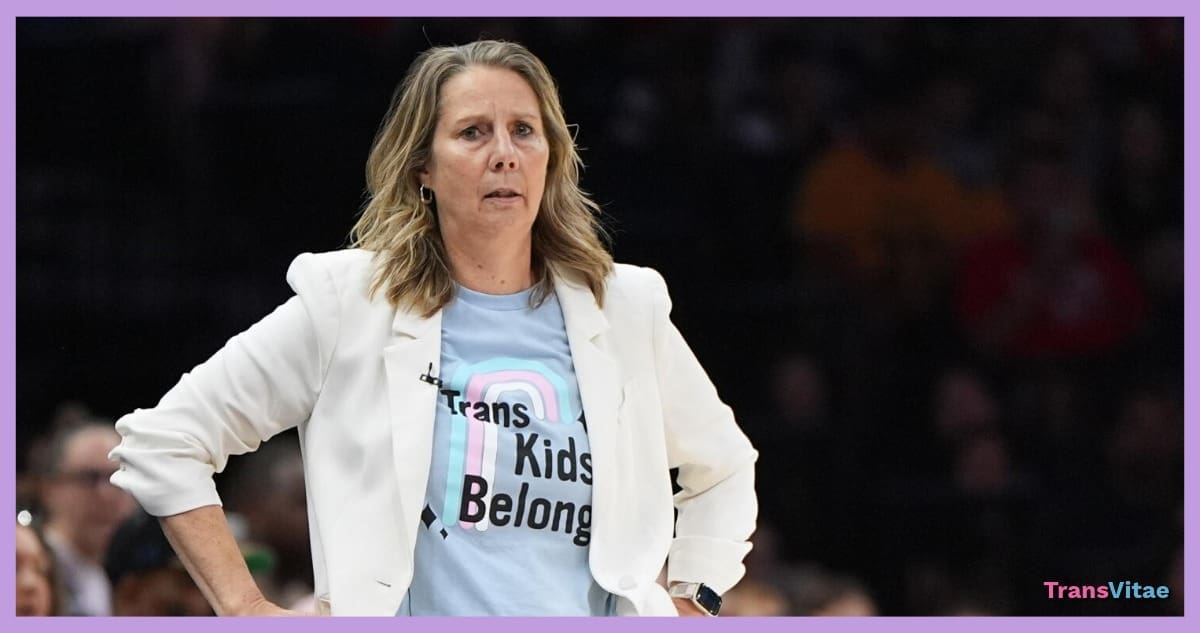
Minnesota Lynx head coach Cheryl Reeve says the increasingly heated debate over transgender athletes has moved well beyond basketball, arguing that the political and cultural campaign surrounding trans participation in sports has become an attack on transgender people more broadly.
Reflecting on the 2026 WNBA season, Reeve pointed to one seemingly small moment that became surprisingly meaningful: wearing a “Trans Kids Belong” shirt beneath her jacket during an August game against the Indiana Fever.
For Reeve, the gesture was never just about who gets to step onto a basketball court.
“The transgender community is one that deserves our support,” Reeve said, adding that what is happening under the banner of transgender sports debates has become “an attack on all transgender community.” She went further, saying, “They don’t want transgender people to exist.”
Reeve said she subsequently heard from transgender people and parents of transgender children who told her that seeing someone with her platform publicly support them made a difference.
That reaction, she said, reinforced why speaking publicly mattered.
The moment came during a season in which transgender athletes became an unlikely recurring storyline around the WNBA.
Indiana Fever guard Sophie Cunningham helped ignite the controversy in July when she said transgender women should not participate in women’s sports. Cunningham has maintained that her position is about protecting women’s athletics and has said she does not hate transgender people. Her comments nevertheless generated protests, counterprotests, and weeks of questions directed at WNBA players and coaches.
Golden State Valkyries coach Natalie Nakase publicly took the opposite position, saying sports should be about belonging and explicitly stating that transgender women should be included. Reeve’s “Trans Kids Belong” shirt appeared during the same weekend.
The WNBA itself has attempted to navigate the controversy without allowing the conversation to overwhelm the league. Commissioner Cathy Engelbert told teams in August that transgender participation was receiving significant attention and urged league officials to approach discussions with “integrity and respect.” The league later denounced what it characterized as bad-faith efforts surrounding the debate.
For Reeve, however, the significance of the issue extends far beyond eligibility rules.
Her message is that transgender people watching these debates are also hearing a larger argument about whether they belong in public life at all.
That is why a T-shirt mattered.
Reeve described wearing it as a small gesture. But for families accustomed to watching transgender people discussed endlessly as a controversy, seeing one of professional basketball’s most prominent coaches simply say that trans kids belong carried considerably more weight.
Sometimes allyship isn’t complicated. Sometimes it is four words on a T-shirt and refusing to hide them.
