


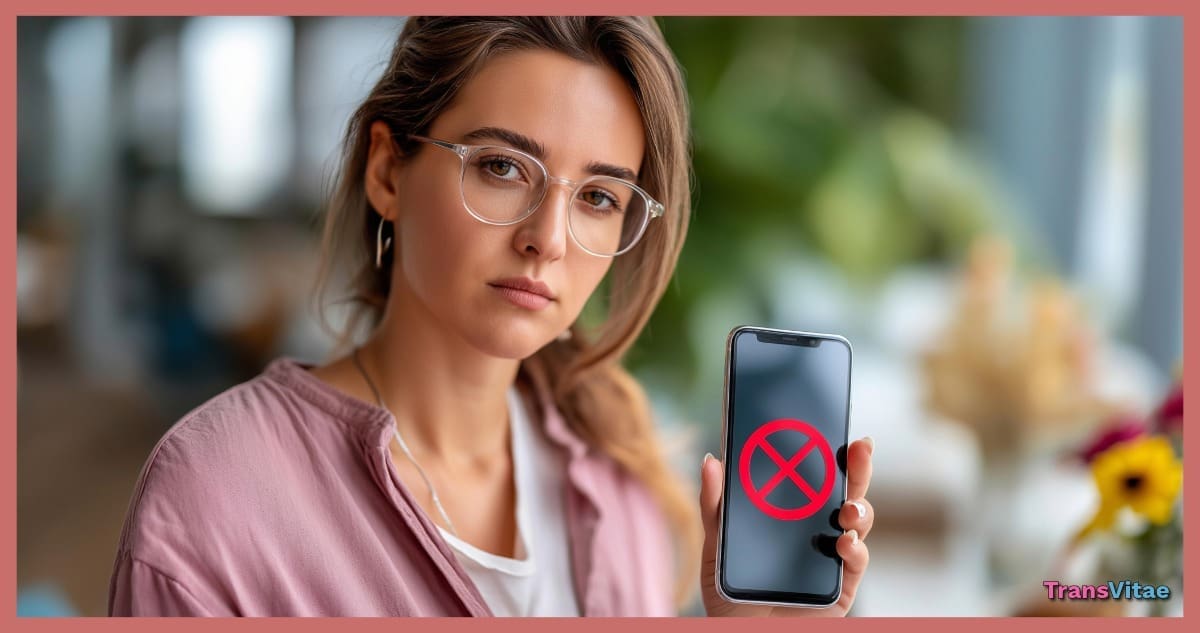
There is a peculiar kind of grief that comes from blocking someone you still care about.
There may be no screaming match. No betrayal dramatic enough for a Netflix miniseries. Nobody necessarily did one unforgivable thing. Sometimes there is simply the painful realization that having access to someone, seeing their name, waiting for their messages, and wondering where you stand with them is hurting you more than their presence is helping you.
And sometimes you have to close the door.
For transgender women, that decision can carry some additional emotional weight. Many of us have already learned what it feels like to lose people. Transition has a nasty habit of revealing which relationships were unconditional and which came with fine print. Family members disappear. Friends become uncomfortable. Romantic relationships change. Coworkers suddenly behave differently.
So when someone has actually been there for us, especially during vulnerable parts of our lives, walking away from that person can feel almost unnatural.
But protecting yourself does not require proving that someone else is a terrible person.
Sometimes the relationship simply hurts.
Step One: Admitting That the Relationship Has Changed
This may be the hardest part because memory is a persuasive little bastard.
You remember the conversations. The laughter. The times they showed up. The things they knew about you that almost nobody else did. Maybe they were there during transition, when you were learning how to exist publicly as yourself. Maybe they knew you before everyone else did.
Those memories are real. But memories are historical documents, not current relationship status reports. A relationship can have been wonderful and still no longer be good for you.
That distinction matters because people often remain emotionally attached to what a relationship was long after they have become unhappy with what it is.
The first emotional step, then, isn’t anger. It is honesty. Stop asking, “Was this person important to me?” Of course they were. Ask instead, “What does this relationship do to me now?”
Do you regularly feel anxious after interacting with them? Are you constantly wondering whether they will message? Do you analyze response times, tone or social media activity? Do you find yourself comparing how they treat you with how they treat other people?
Most importantly, are you spending considerably more emotional energy thinking about the relationship than actually enjoying it? Those questions can tell you more about the present than nostalgia ever will.
Step Two: Understanding Why It Can Hit Trans Women Differently
Transgender people don’t experience relationships inside a psychological vacuum.
Research into minority stress has repeatedly found that transgender people contend with rejection, discrimination, and the expectation of future rejection. One study specifically examining transgender people found heightened attention to social feedback and connections between responses to evaluation and later measures, including anxiety, resilience, and self-esteem.
That doesn’t mean every transgender woman becomes hypersensitive to rejection. We aren’t a monolith, despite what the internet apparently believes before breakfast.
It does mean our relationship histories may contain more rejection than those of many cisgender people.
That history matters.
When you’ve already lost people because you transitioned, finding someone who sees you can become incredibly meaningful. They aren’t merely another friend. They may become associated with safety, acceptance, and a period of your life when you desperately needed both.
Research also suggests social support can be an important resilience factor for transgender people experiencing minority stress.
So losing an important relationship may feel like more than losing one person. You may feel as though you’re losing part of your support system. That can make us hang on longer than we otherwise would.
Step Three: Accepting That You Don’t Need a Villain
This one matters.
We have become accustomed to relationship advice that requires assigning roles. Someone is toxic. Someone is narcissistic. Someone is manipulative. Someone is the victim.
Real relationships are usually messier. A person can care about you and disappoint you.
Someone can have been a wonderful friend during one chapter of your life and become emotionally unavailable during another. And someone does not have to mistreat you intentionally for their presence to become unhealthy for you.
You don’t need to prosecute a case before a jury to justify creating distance.
Sometimes the only question that matters is whether maintaining the connection is causing you to spiral. If the answer is yes, stepping away isn’t punishment; it’s protection.
Step Four: Making the Decision Before the Next Emotional Moment
There is a cycle that can develop when an important relationship becomes inconsistent.
- You feel hurt.
- You decide you’re finished.
- Then they message.
- Suddenly you feel better.
- For a little while.
- Then the distance returns and you’re right back where you started.
This intermittent contact can make detachment extraordinarily difficult because every interaction resets hope. You aren’t only reacting to the relationship. You’re waiting for the version of the relationship you remember to come back.
This is where boundaries become important. A boundary isn’t “You need to behave differently.” That’s a request.
A boundary is “If this continues affecting me this way, this is what I am going to do.” Sometimes that means communicating less. Sometimes it means muting someone. And sometimes it means blocking them completely.
Step Five: Understanding Why Blocking Can Be Self-Protection
The word block sounds aggressive. It feels like slamming a digital door. But blocking doesn’t necessarily mean “I hate you.”
Sometimes it means, “I know myself well enough to know that leaving this door cracked open will keep me standing beside it.”
Social media makes separation particularly difficult because relationships rarely disappear anymore. Someone can be absent from your life while remaining constantly present on your screen.
Research published in 2026 examining social media observation after romantic breakups found that both intentionally checking on former partners and passively encountering them online were associated with worse emotional outcomes. The researchers suggested that unfollowing, muting, or blocking may help with recovery. While friendship loss isn’t identical to romantic separation, the underlying digital problem is recognizable: access can keep emotional wounds active.
You see that they’re online. You notice they posted something. You wonder why they haven’t contacted you. You check again.
Congratulations. Your smartphone has transformed into a pocket-sized anxiety dispenser. Blocking can interrupt that loop. Not because the other person deserves punishment. Because you deserve quiet.
Step Six: Expecting Grief After You Do It
Here’s the annoying part nobody tells you. Making the right decision doesn’t necessarily make you feel good.
- You might block someone and immediately cry.
- You might wonder whether you overreacted.
- You might reach for your phone ten times during the first day.
- You might desperately want them to find another way to contact you, while simultaneously knowing that contact is exactly what you’re trying to escape.
Contradictory feelings don’t mean you made the wrong decision.
Friendship loss can produce genuine grief, particularly because friendships often end without the rituals we associate with romantic breakups. There may be no official ending, no socially recognized mourning period, and sometimes no satisfying explanation.
You’re grieving the person, but you’re also grieving possibility. The conversations you thought you’d have. The trips you imagined. The friendship you assumed would still exist five years from now.
And perhaps most painfully, you’re grieving the version of them who once made you feel important.
Step Seven: Stop Checking Whether They Miss You
This is brutal. It is also necessary.
When someone mattered deeply, we naturally want evidence that our absence matters to them.
- Did they notice?
- Are they upset?
- Did they try contacting me somewhere else?
- Do they miss me?
But healing cannot depend upon obtaining proof that somebody else is hurting.
Maybe they miss you terribly. Maybe they don’t. Maybe they’ll realize what happened next week. Maybe six months from now. Maybe never.
None of those possibilities changes the reason you stepped away. Your boundary cannot secretly become a test where you’re waiting to see whether someone loves you enough to break through it.
Otherwise you haven’t actually left. You’ve simply moved into the emotional waiting room.
Step Eight: Let Yourself Remember the Good Parts
You don’t have to rewrite history to move forward. This may be particularly important when the person played a meaningful role during your transition.
If they encouraged you when you were frightened, that happened. If they made you laugh during horrible days, that happened. If they helped you become more comfortable with yourself, that happened too. Ending a relationship does not retroactively cancel its value.
You can appreciate what someone gave you while acknowledging that you can no longer keep paying the emotional price of having them in your life.
Those ideas can coexist. Humans are inconveniently complicated like that.
Step Nine: Fill the Empty Space Deliberately
When someone occupies significant emotional territory, removing them creates a vacuum.
Don’t underestimate it.
You may suddenly have nobody to send a particular joke to. You may instinctively reach for your phone when something happens. Certain songs, restaurants, or ridiculous memes may remind you of them.
That space needs somewhere to go.
Reconnect with other friends. Spend time with people who reciprocate your energy. Get outside. Make art. Go to the gym. Take photographs. Play games. Travel. Write. Find community.
For transgender women especially, maintaining supportive connections matters. Research has repeatedly identified social support and resilience as protective factors in the context of minority stress.
Walking away from one important relationship shouldn’t mean walking away from connection itself.
Step Ten: Eventually, Stop Measuring the Loss
At first you may count. Three days since we talked. A week. A month. Eventually you won’t.
That’s when something subtle begins happening. Their name stops being the first thing you look for when you pick up your phone.
You remember something funny and don’t immediately think about sending it to them. You realize you haven’t checked whether they’ve tried contacting you.
The emotional volume gets turned down. Not because they suddenly meant nothing. Because they once meant something enormous, and you finally learned how to carry that history without allowing it to control your present.
The Bottom Line
There is an especially painful lesson buried inside adulthood: not everyone we love is supposed to remain in our lives forever.
Some people accompany us through enormous transformations. They see versions of us few others ever knew.
For transgender women, those relationships can become woven into the story of becoming ourselves. That makes losing them hurt like hell. But gratitude is not a lifetime contract. Neither is history.
Sometimes self-love looks glamorous: the dress, the lipstick, and the first photograph where you finally recognize the woman staring back at you.
Sometimes self-love looks considerably less Instagram-ready.
Sometimes it looks like sitting alone with your phone, crying over someone who once mattered tremendously, pressing Block, and knowing you may spend the next several weeks questioning whether you should undo it.
Then choosing not to. Not because you stopped caring. Because caring about someone and protecting yourself are not mutually exclusive.
You don’t have to hate someone to remove them from your life. You don’t have to erase what they meant to you, and you don’t have to prove they were a bad person.
Sometimes the most painful boundary is the one placed around someone who was once very good to you. The relationship mattered. The memories mattered. The person mattered. But eventually, you have to matter too.
