


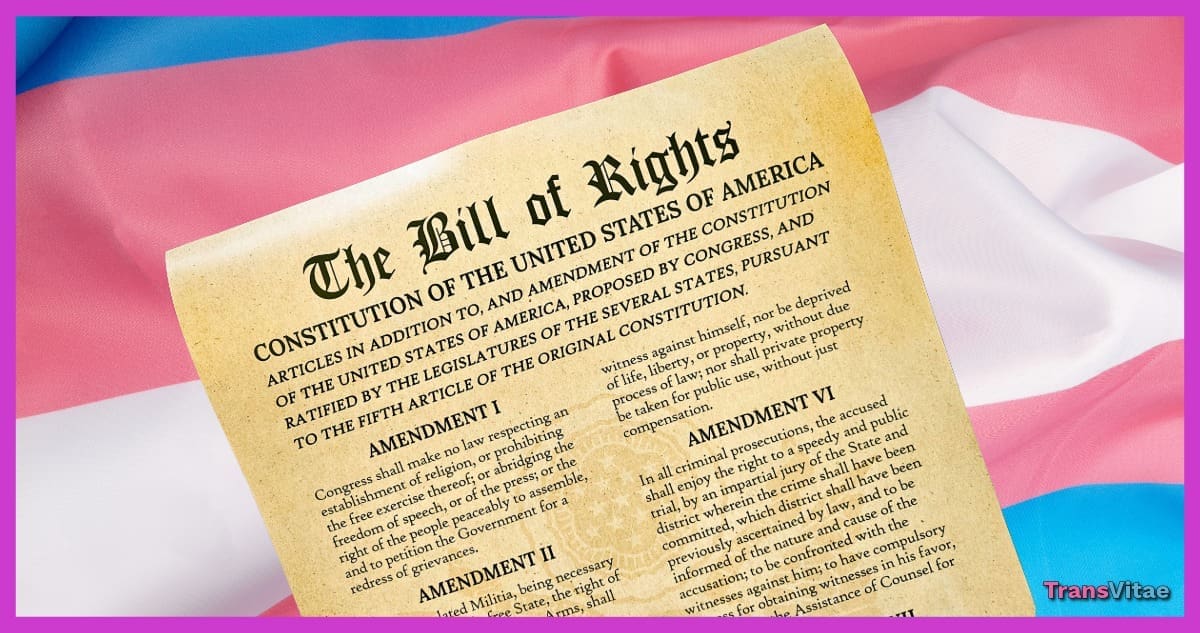
When members of Congress reintroduce a Transgender Bill of Rights, the pushback is immediate and predictable. Critics roll out the same rhetorical challenge: What rights don’t transgender people already have?
On its surface, the question sounds reasonable. After all, the Constitution does not list rights by identity group. If laws apply to everyone equally, the argument goes, then transgender people already have the same rights as anyone else. Case closed.
Except it is not closed. And it has never been that simple.
The question itself is structured to obscure the real issue. It frames equality as a theoretical concept rather than a lived reality. It assumes that having rights “on paper” is the same as being able to exercise them safely, consistently, and without discrimination. That assumption is where the problem begins.
Rights on Paper Versus Rights in Practice
In theory, transgender Americans have the right to work, seek medical care, attend school, rent housing, travel freely, and participate in public life. Those are baseline civil rights.
In practice, those rights are often conditional, unevenly protected, or actively undermined by policy, enforcement gaps, and targeted legislation.
Take employment. In 2020, the Supreme Court’s decision in Bostock v. Clayton County clarified that discrimination based on sexual orientation or gender identity falls under Title VII’s prohibition on sex discrimination. That ruling was historic and meaningful. But it did not end workplace discrimination. It created a legal pathway to challenge it.
The difference matters. The ability to sue after being fired is not the same as protection from being fired in the first place. Litigation is expensive, time-consuming, and emotionally draining. Many people cannot afford to pursue it. A right that exists only after harm has occurred is not the same as a right that prevents harm.
The same pattern appears in housing, education, and health care. Federal agencies may interpret existing statutes to include gender identity protections. Future administrations can reinterpret them. States can test the boundaries. Courts can narrow them. The legal landscape becomes unstable.
That instability is precisely why codification efforts matter.
RELATED: What Rights Have Been Taken From Transgender People?
Access to Health Care Is Not Abstract
One of the clearest examples of the gap between theory and reality is health care.
Transgender people technically have the right to seek medical care like anyone else. But across the country, lawmakers have introduced and in some cases passed bans or restrictions on gender-affirming care. For minors, the restrictions are sweeping in many states. For adults, access is increasingly under scrutiny through insurance exclusions, funding limits, and regulatory pressure.
Even where care is legal, it is not always accessible. Insurance plans may exclude coverage for gender-affirming procedures. Providers may refuse treatment. Rural areas may have no competent specialists. Federal protections under Section 1557 of the Affordable Care Act have been repeatedly revised depending on the administration in power.
Critics say, “You can still get care somewhere.” But rights that require relocation, personal wealth, or legal battles are not equally distributed rights. They become privileges.
A Transgender Bill of Rights framework seeks to clarify that medically necessary, evidence-based care should not depend on ZIP code or election cycles. It aims to move from patchwork interpretation toward stable, enforceable standards.
Identity Documents and Everyday Function
Another example often dismissed in public debate involves identity documents.
Transgender Americans technically have the right to obtain driver’s licenses, passports, and birth certificates. But the ability to update gender markers varies widely by state. Some states allow self-attestation. Others require medical documentation. A few restrict changes entirely.
This is not cosmetic. Identification documents are required for employment verification, travel, banking, housing applications, and voting in many jurisdictions. Mismatched documents can lead to outing, harassment, or denial of service.
When critics ask what rights are missing, they overlook how bureaucratic barriers function as gatekeeping mechanisms. If someone must prove medical intervention to update documents, that requirement imposes a financial and medical threshold not demanded of others.
Equal protection is not merely about access to the DMV. It is about being able to move through public life without constant friction or forced disclosure.
Public Accommodations and Safety
Public accommodations are another area where the rhetorical question falls apart.
In some states, transgender people are explicitly protected in public accommodations. In others, they are not. In still others, lawmakers have attempted to restrict restroom or facility access based on birth-assigned sex.
Critics frame these debates as safety concerns. Supporters of transgender rights frame them as dignity and equal access issues. But beyond rhetoric, the underlying legal question is straightforward: Should transgender people be able to use public facilities consistent with their gender identity without fear of ejection or arrest?
If the answer is yes, then the right must be clear, consistent, and enforceable. If the answer varies by state, by school district, or by local ordinance, then equality is fragmented.
A federal rights framework seeks to establish baseline standards that do not shift with local politics.
Education and Youth Protections
Education policy has become a major battleground. From sports participation to pronoun use, school districts have faced intense political pressure.
Transgender students technically have the right to attend public school. But whether they are allowed to use chosen names, access appropriate facilities, or participate in athletics varies widely. Some states require schools to notify parents if a student uses different pronouns. Others prohibit such disclosure.
The question of rights here is not about attendance. It is about whether transgender students are afforded the same educational environment free from discrimination and targeted exclusion.
When lawmakers propose bills that single out transgender youth for unique restrictions, that signals a differential standard. A Transgender Bill of Rights asserts that transgender students deserve equal educational opportunity without political interference in their identity.
Why Codification Matters
Opponents often argue that new legislation creates “special rights.” Supporters counter that codification prevents erosion.
Civil rights history shows that clarity reduces ambiguity. The Civil Rights Act of 1964 did not invent equality. It clarified and enforced it. The Americans with Disabilities Act did not create new rights from thin air. It operationalized access.
Similarly, a Transgender Bill of Rights does not create a separate constitutional tier. It articulates how existing principles of equal protection and nondiscrimination apply in modern contexts where transgender people are disproportionately targeted.
Without codification, protections remain vulnerable to administrative rollback. Agencies can reinterpret rules. Courts can narrow definitions. Political leadership can deprioritize enforcement.
Codification sends a signal that equality is not contingent.
The Political Function of the Question
The repeated demand, “What rights don’t transgender people have?” serves a political function.
It reframes the conversation from lived discrimination to abstract legality. It implies that unless a right is explicitly denied in statutory text, discrimination does not exist. It shifts the burden onto marginalized people to prove harm beyond reasonable doubt before protection is considered.
The same argument was once used against other civil rights expansions. If women could technically work, why pass workplace protections? If Black Americans could technically vote, why pass voting rights enforcement?
The answer is always the same: because technical permission without structural protection is fragile.
Enforcement Is Part of the Right
Rights are not self-executing. They require enforcement mechanisms.
For transgender people, enforcement often depends on costly litigation. Filing complaints with federal agencies can take months or years. Court cases can stretch longer. Many individuals lack the resources to pursue them.
A comprehensive rights framework can strengthen enforcement provisions, clarify agency responsibilities, and reduce ambiguity that leads to inconsistent rulings.
Critics sometimes argue that courts already provide remedies. But remedies after harm are not the same as preventative safeguards. Civil rights law functions best when it deters discrimination before it occurs.
Federal Consistency in a Patchwork Landscape
The United States currently operates under a patchwork system. Some states have robust protections for transgender residents. Others have enacted restrictions that limit access to care, facilities, or recognition.
This geographic disparity creates internal migration pressures. Families relocate for medical access. Workers move for legal protection. Students transfer schools.
When rights depend on geography, equality becomes uneven. Federal standards provide baseline protections that do not erase state authority but establish a floor below which states cannot go.
That stability benefits not only transgender individuals but also employers, schools, and medical providers seeking consistent guidance.
The Broader Impact
The debate over transgender rights has become symbolic of broader cultural conflict. But for transgender individuals, it is practical and immediate.
It determines whether someone can update identification without invasive requirements. Whether a teenager can attend school without forced outing. Whether an adult can access medically recommended care. Whether a worker can remain employed without concealment.
The Transgender Bill of Rights is not about symbolism alone. It is about clarifying that equal protection extends fully and explicitly to transgender and nonbinary Americans.
When critics insist that no rights are missing, they focus on abstract constitutional language. When supporters advocate codification, they focus on implementation, enforcement, and stability.
Both sides claim to defend equality. The difference lies in whether equality is treated as theoretical or operational.
The Importance of Clear Standards
Clear standards reduce litigation, confusion, and political manipulation. They help courts interpret laws consistently. They guide agencies in enforcement. They give individuals confidence that protections will not disappear with the next administrative shift.
In a climate where transgender issues are frequently used as political flashpoints, clarity can lower temperature by replacing ambiguity with defined policy.
A Transgender Bill of Rights resolution may not itself create binding law, but it establishes a framework and a public record of legislative intent. It signals where federal lawmakers believe equal protection should stand.
The Bottom Line
The question, “What rights don’t transgender people have?” assumes that equality is static and self-evident. It assumes that once a principle exists in court precedent, it is permanently secure.
History suggests otherwise.
Rights require reinforcement. They require clarity. They require enforcement. And they require acknowledgment that legal theory and lived experience can diverge.
The reintroduction of a Transgender Bill of Rights is not an admission that transgender Americans have no rights. It is a recognition that rights must be explicit, durable, and uniformly applied.
For those who believe in equal protection under the law, the real question is not what rights transgender people lack in theory. It is whether those rights function reliably in practice.
That is the gap this legislation seeks to address.
