


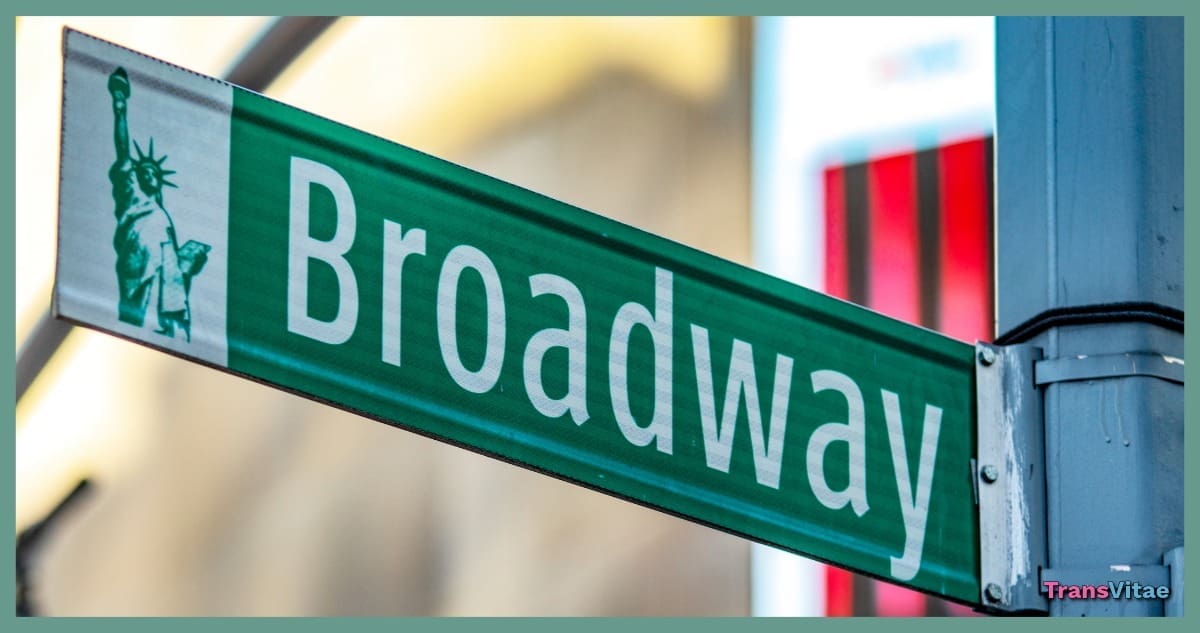
Broadway thrives on transformation. It always has. From actors playing roles far removed from their own lives to productions that reinvent history, gender, and identity, the stage has long been a place where reality bends in service of art. Yet when transgender performers step into visible, mainstream Broadway roles, that tradition of reinvention suddenly becomes controversial to some audiences.
That tension is at the heart of the latest debate following the announcement that Dylan Mulvaney will make her Broadway debut in Six: The Musical, playing Anne Boleyn beginning February 16 at the Lena Horne Theatre. The excitement around her casting has been matched by a familiar online uproar from anti-trans groups, gender-critical activists, and self-described defenders of “women’s spaces.”
This reaction says far less about Broadway than it does about who is still considered acceptable in public cultural life.
Broadway Has Always Played With Gender
Musical theater is not new to gender nonconformity. Long before modern conversations about transgender identity, the stage made room for cross-casting, drag, exaggerated femininity and masculinity, and characters who existed outside rigid norms. Shakespeare’s work relied on gender swapping. Vaudeville and early Broadway reveled in it. Camp has always been part of the language of theater.
For decades, audiences accepted these conventions as art.
What has changed is not Broadway’s relationship with gender, but society’s anxiety about transgender people existing openly. When a cis actor plays across gender, it is called performance. When a trans performer does the same, it is suddenly framed as ideology.
That double standard is what fuels so much of the backlash.
Dylan Mulvaney and the Weight of Visibility
Dylan Mulvaney is one of the most recognizable transgender women in American media. Her visibility did not come quietly. She became widely known through social media, documenting her transition with humor, vulnerability, and theatrical flair. That visibility has also made her a lightning rod.
To critics, Mulvaney is never just a performer. She is treated as a symbol, a provocation, or a stand-in for broader cultural fears. Her Broadway casting was almost immediately framed not as a theater decision, but as another front in the culture wars.
What is often ignored in that framing is her professional background. Mulvaney trained in musical theater, has toured nationally, and recently performed an off-Broadway one-woman show. She is not stepping onto a Broadway stage as a stunt. She is stepping onto it as a performer.
The refusal to acknowledge that distinction is intentional. Reducing trans artists to their identity allows critics to dismiss their work without engaging with it.
RELATED: Dylan Mulvaney Cast in Six as Anti-Trans Critics React
Why Six Became a Flashpoint
Six: The Musical is a high-energy pop reimagining of the six wives of Henry VIII. It centers women reclaiming their narratives from history, turning tragedy into empowerment and spectacle. The show is explicitly modern, playful, and unconcerned with strict historical realism.
That makes it a magnet for backlash.
Anti-trans critics have leaned heavily on the idea that Six is a “women-centered” show and therefore unsuitable for a trans woman. This argument relies entirely on denying that trans women are women. Without that premise, the outrage collapses.
It is also deeply inconsistent. Broadway audiences rarely object to creative liberties taken with history, race, accent, or personality. Objections only arise when the performer is transgender. That selectivity exposes the bias underneath the rhetoric.
The Familiar Pattern of Online Backlash
The response to Mulvaney’s casting followed a now predictable cycle.
Announcement. Celebration. Backlash. Comment sections flooded with misgendering, accusations of erasure, and claims that trans inclusion is an attack on women. Production accounts limit comments or lock posts. Critics cry censorship. The outrage migrates elsewhere.
This cycle is not accidental. Outrage generates clicks, engagement, and, in some cases, income. For certain anti-trans influencers and organizations, a visible trans person in a prestigious space is an opportunity.
The goal is not debate. The goal is deterrence.
If enough noise can be generated, institutions may decide it is easier to avoid trans inclusion altogether. That is the real purpose of the uproar.
Trans Performers on Broadway Are Still the Exception
There is a persistent myth that Broadway is overflowing with transgender performers simply because it is a queer-friendly industry. The reality is more limited.
There have been meaningful milestones. Peppermint’s Broadway debut in Head Over Heels marked a widely recognized breakthrough. L Morgan Lee’s Tony nomination for A Strange Loop was historic. These moments mattered because they were rare.
The fact that each one is still framed as a first or a milestone underscores how narrow access remains. Trans performers exist across theater, but opportunities in long-running, high-profile productions are still comparatively few.
Visibility exists. Equal footing does not.
Representation Beyond Trans Specific Roles
One of the most important aspects of transgender visibility in theater is the distinction between representation and range.
Trans stories deserve to be told. But trans performers also deserve access to roles that are not defined by being trans. If the only acceptable roles for trans actors are those that explain trans identity to cis audiences, then inclusion becomes conditional and limiting.
Mulvaney playing Anne Boleyn matters because the role is not about her gender identity. It is about performance, charisma, and command of the stage. That kind of casting treats trans performers as artists first, not educational tools.
That shift is threatening to those who believe trans people must always justify their presence.
The Broader Political Climate
The backlash to trans visibility on Broadway does not exist in isolation. It is part of a broader environment where transgender people are routinely politicized.
Trans bodies are debated in legislatures, courtrooms, school boards, and media panels. Visibility is framed as danger. Existence is framed as controversy.
In that climate, a trans woman standing center stage on Broadway becomes more than a casting decision. It becomes a symbol of resistance to enforced invisibility.
That is why the reactions are often disproportionate. The anger is not about one musical. It is about who gets to be seen as legitimate in public life.
The Myth of Protecting Women’s Spaces
One of the most common arguments raised against trans performers in Broadway productions is the claim of protecting women’s spaces. In theater, this argument collapses under even minimal scrutiny.
A Broadway stage is not a private space. It is a workplace and a performance venue. Roles are not assigned based on biology. They are assigned based on talent, interpretation, and artistic vision.
The argument only appears when the performer is trans. It does not appear when actors cross racial, national, or historical boundaries. It does not appear when characters are radically reimagined. It appears selectively.
That selectivity reveals that the concern is not about women. It is about excluding trans women.
Why Visibility Still Matters
Visibility is not a cure-all. Seeing a trans performer on Broadway does not automatically dismantle discrimination. But it does something important.
It disrupts the narrative that trans people do not belong in mainstream culture. It offers trans audiences a mirror that reflects possibility rather than limitation. It normalizes trans presence in spaces associated with prestige and legitimacy.
For cis audiences, it does something quieter but just as important. It makes trans inclusion ordinary.
That ordinariness is exactly what anti-trans movements fear.
The Business Reality of Broadway
Broadway is not just art. It is an expensive industry that survives on ticket sales, tourism, and name recognition. Casting decisions are often shaped by who can draw an audience.
That reality cuts both ways.
On one hand, producers may fear controversy. On the other hand, visible performers with large followings can help fill seats. The assumption that trans performers are bad for business is increasingly unsupported by evidence.
Online outrage does not always translate into empty theaters. Many of the loudest critics are not Broadway ticket buyers. They are participants in a digital outrage economy.
When productions choose inclusion anyway, they challenge the idea that trans visibility is a financial liability.
What Real Allyship Looks Like in Theater
Support for trans performers cannot stop at casting announcements. It has to include action when backlash hits.
That means clear public messaging. It means moderating harassment rather than letting performers absorb it alone. It means focusing coverage on craft and performance instead of controversy.
It also means audiences showing up. Buying tickets. Applauding loudly. Refusing to let internet noise define the success of inclusive casting.
Allyship is not theoretical. It is visible and material.
The Bottom Line
Dylan Mulvaney’s Broadway debut is not an isolated moment. It is part of an ongoing negotiation over who gets access to cultural legitimacy.
Broadway likes to see itself as progressive, and sometimes it is. But progress has rarely come without pressure. Trans performers being visible in mainstream productions is not a gift. It is the result of persistence, talent, and refusal to disappear.
The backlash tells one story. The casting tells another.
One side is invested in narrowing who belongs. The other is expanding the stage.
Broadway, like the rest of society, is being asked to choose which story it wants to tell.

I love that girl