


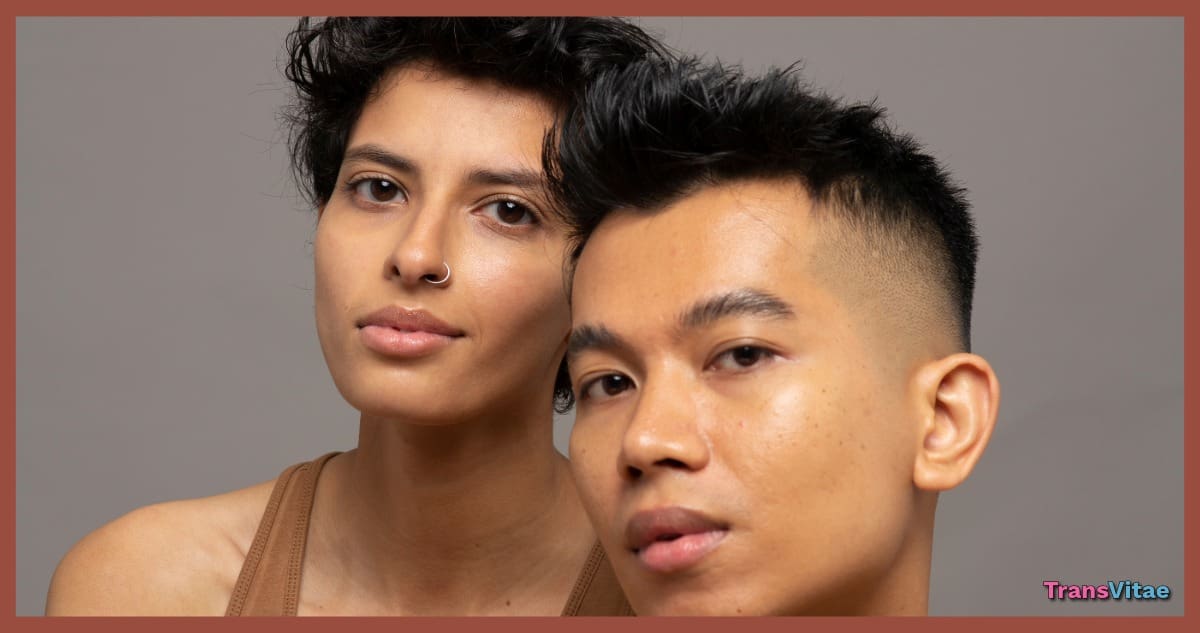
If you came out any time before the TikTok-era trans culture, you probably absorbed one rule: pick a lane. If you are a trans woman, you were supposed to be ultra feminine. If you are a trans man, you were supposed to be aggressively masculine. Anything androgynous was treated as confusion at best and transition failure at worst.
That script is breaking.
Across social media, in real-life communities, and in new survey data about gender identity, more transgender people are choosing androgynous presentation or fluid expression instead of chasing a hyper feminine or hyper masculine ideal. Some identify as nonbinary and trans. Some are binary trans people who simply feel most themselves somewhere in the middle. And many early transition folks, like our author, are realizing their own comfort lives in a softer, mixed lane, not at the far ends.
So what changed, and why does androgyny suddenly feel less like failure and more like liberation?
What We Used To Be Told Transition Should Look Like
For a long time, trans people were coached, nudged, or outright forced into a very narrow image of success.
Medical gatekeepers often wanted you to convincingly “live as” your target gender in a very binary, stereotypical way before offering hormones or surgery. Hyper femininity or hyper masculinity became proof that you were “serious.” If you were a trans woman and did not want long hair, dresses, and full glam, you risked being labeled confused. If you were a trans man who liked eyeliner or skirts, people questioned whether you were “really” a man.
Community norms piled on. Older message boards, early forums, and some in-person support groups treated passing as the absolute win condition. If you did not blend perfectly into a binary box, you were supposed to fix yourself until you did.
There was almost no room to say, “What if my gender is binary, but my style, vibe, and daily presentation are not?”
The Culture Shift: From Passing At All Costs To Feeling Like Yourself
Over the last decade, especially among younger generations, that pressure started to crack.
More people now identify under the broader transgender umbrella, and a large share identify as nonbinary or gender nonconforming. A recent analysis from the Williams Institute estimates about one-third of transgender adults in the United States are nonbinary, alongside trans men and trans women in roughly equal numbers. Youth are even more likely to live somewhere on the nonbinary or gender-expansive spectrum.
Other research from groups like The Trevor Project has found that more than one in four LGBTQ youth identify as nonbinary, with more questioning if that label might fit them. While these studies focus on identity rather than clothing or presentation, they point to a broader truth. There is simply more oxygen for gender that does not line up neatly with “woman equals lipstick and heels” or “man equals beard and flannel.”
At the same time, mainstream psychology and advocacy orgs now describe gender expression as something separate from gender identity. They explicitly include androgynous, multigender, and gender nonconforming people within the transgender umbrella when their identity or experience aligns there. Definitions of androgyny highlight that it is often about how you present on the outside, not a requirement for how you identify on the inside.
Put simply, the old pass-or-fail rubric is losing its grip. And that frees more of us to experiment.
Why Are More Trans People Choosing Androgynous Presentation?
There is no single reason, but several forces are pushing the culture toward something more mixed, fluid, and personal.
Nonbinary And Gender Expansive Identity Is More Visible
Nonbinary people have always existed, but they were rarely centered in medical research, community narratives, or media coverage. That has started to change. Recent reviews of nonbinary lives highlight that many nonbinary people do not want their bodies or clothes to be pushed to one extreme. Instead, their ideal is often neutralizing, blending, or selectively emphasizing traits, rather than fully feminizing or masculinizing everything.
When nonbinary people share their lives on platforms like TikTok, Instagram, and YouTube, they make visibly androgynous presentation feel normal, not experimental. One study of nonbinary creators on TikTok found a huge diversity of gender expression, from binary-leaning to androgynous to wildly fluid, all coexisting in one feed.
That visibility rubs off on everyone. Binary trans people watching those videos get permission to ask themselves: what if I do not want the “final form” society expects. What if I just want to look like me.
Safety And Survival In A Hostile Climate
Not every androgynous trans person is making a pure aesthetic choice. Sometimes androgyny is armor.
In a political moment where anti-trans legislation and harassment are rising, it can feel safer to blur your visual cues. You might still know yourself as a woman, man, or nonbinary person, but choose clothing or hair that draws less attention or allows you to move through hostile spaces with fewer confrontations.
That does not make your gender less real. It reflects the basic calculus of survival. Many of us dial up or dial down certain traits depending on where we live, what job we work, or how hostile our local laws and culture are toward trans people.
And in some cases, androgyny offers strategic ambiguity. Strangers do not instantly tag you as a “man in a dress” or “girl trying to be a boy.” You show up as a person who does not map neatly onto their stereotypes, which sometimes lowers their sense of entitlement to comment at all.
The Cost Of Performing Hyper Femininity Or Hyper Masculinity
Hyper feminine and hyper masculine scripts are expensive. Money, time, energy, recovery. To maintain them, you are often expected to:
- Buy very gendered wardrobes for every season
- Spend significant time on makeup or grooming
- Commit to specific hair patterns, laser, or electrolysis schedules
- Hit gyms or diet routines designed to chase a single body silhouette
For some trans people, that work genuinely brings joy. For others, especially those in early transition juggling HRT, mental health, jobs, family, and possibly medical procedures, the grind can turn into burnout.
Androgynous presentation can be a way to opt out of that grind without opting out of transition. Neutral basics, simple haircuts, and softer shapes can feel more sustainable. You can still affirm your gender, but you are not clocking in for a full-time performance job every morning.
Bodies That Do Not Fit The Binary Script
Research with nonbinary and gender-diverse people shows that their dysphoria often centers on specific body areas or social misgendering, rather than an all-encompassing desire to completely feminize or masculinize every feature. Some want flat chests and soft faces. Others want curves but enjoy short hair and no makeup. Many want something that simply does not exist in cisgender beauty templates.
Binary trans people can feel this too.
Our bodies come preloaded with genetics, health conditions, and life history. Hormones will do some things, surgery can change some things, but there is no guarantee you will ever match that hyper-idealized mental image. For some of us, trying to chase it actually worsens dysphoria because it keeps reminding us of what we cannot reach.
An androgynous or selectively gendered style can be kinder. Instead of forcing your body into a mold, you choose clothes, cuts, and silhouettes that work with what you have and what HRT gives you, not against it.
Fashion And Pop Culture Are More Fluid
Outside of explicitly trans spaces, mainstream fashion has been flirting with androgyny for years. Gender-neutral clothing lines, oversized silhouettes, masc women and fem men in media, and celebrities blurring categories on red carpets, all of that has softened expectations around what clothing belongs to which gender.
If cis people can get away with mixing it up, trans people are absolutely going to join in.
For a trans woman, this might look like comfortable jeans, loose tees, and sneakers most days, reserving dresses and heels for when she feels like it, not because she “has to” in order to count. For a trans man, it might mean keeping painted nails or softer fabrics in rotation without letting anyone revoke his guy card.
Once the wider culture loosens its grip on the binary, trans people have that much more room to breathe.
The New Pressure: Looking Perfectly Androgynous
Of course, humans never met a norm they did not try to turn into a new rule.
Some research and commentary has started to notice a parallel pressure forming. Nonbinary people, in particular, describe feeling like there is now an unofficial androgynous template they are expected to match if they want to be “read” as nonbinary and taken seriously. Think shaved undercuts, boxy clothes, thin bodies, and very specific fashion cues.
If you are nonbinary but present femme, people assume you are a woman. If you are nonbinary but present masc, people assume you are a man. And if you are trans and binary identified but choose androgyny because it is what feels good, some community spaces will still poke you with that old “are you sure” question.
The risk is that we simply trade one rigid performance for another. Yesterday, you were supposed to look like cis Barbie or cis Ken. Today, you are supposed to look like a perfectly balanced glitch in the matrix.
The point of more androgynous options is not to create a new box. It is to give you permission to build your own.
Why This Is Not Failing Your Transition
If you are in early transition, it can feel confusing.
You might have spent years imagining a hyper feminine or hyper masculine future self. Then hormones kick in, your life changes, and you discover that you actually feel best in a mix of traits from both sides or in a look that changes day to day. Part of you might panic and wonder if this means you are “not really” your gender or if you are somehow failing at transition.
You are not.
A few key things are worth repeating here.
- Gender identity is about who you are, not your outfit. The clothes you choose do not revoke your womanhood, manhood, or nonbinary identity.
- Transition is not an exam with answer keys written in 1982. The goals you had before starting might evolve as your body, mental health, and social life evolve.
- Androgyny can be a stable destination or a temporary bridge. Some people live there forever. Others use it while exploring or while accessing care. Both are valid.
Major surveys remind us that the trans community itself is wildly diverse, including large numbers of nonbinary and gender nonconforming people who will never fit a binary script and never want to. When we pretend that transition only counts if you end up at a very traditional binary endpoint, we erase a huge portion of our own family.
How To Navigate Your Own Androgynous Era
If you are reading this as someone who is trans and questioning where you land on the presentation spectrum, here are some grounded ways to experiment without losing yourself.
Give Yourself Permission To Treat This As Data Collection
You do not have to rewrite your labels every time you change outfits. View this as a process of gathering data about your nervous system.
- What outfits make your shoulders loosen instead of hunch?
- When do you feel most at home in your body?
- What types of compliments actually land as affirming, instead of feeling like acting notes from a director?
Notice patterns over time. If you repeatedly feel better in softer, more blended looks, that is data. If you find that androgyny helps you feel safe in hostile spaces but you crave full femme or full masc when you are alone or with trusted friends, that is also data.
Separate Your Wants From Other People’s Reactions
A lot of our early transition choices are driven by fear of judgment. Fear from cis people, fear from our own community, and fear from family. It is easy to get stuck building a gender performance that mostly exists to shut other people up.
Ask yourself:
- If nobody commented on my gender all day, what would I wear tomorrow?
- If my safety and job were completely guaranteed, would I dress differently?
- If my body magically matched my inner sense of self, would I still choose this style?
Your honest answers can reveal whether androgyny is really your jam or whether you are using it as a shield while trying to survive.
Be Honest About Safety Without Letting Fear Own The Story
Acknowledging that politics and harassment shape your choices is not weakness. You live in the world you live in. Sometimes androgynous presentation is the compromise that lets you keep a job, stay housed, or move through public spaces without constant fight or flight.
You are allowed to factor that in. You are also allowed to dream beyond it.
Some people find comfort in having multiple modes. Closeted at work, more fluid around friends, and fully themselves at home or online. That layering does not make any one version less real. It simply reflects the realities of living as a trans person in a hostile culture.
What This Trend Says About The Future Of Transition
The growing comfort with androgynous presentation among trans people is not a sign that transness is fading or that transition is “less serious” now. If anything, it suggests the opposite.
As more of us come out and more data accumulates, researchers consistently find that younger generations are more likely to identify as trans, nonbinary, or otherwise gender expansive. Within that growing population, a wide spectrum of identities and expressions is emerging. That includes hyper femme trans women, hyper masc trans men, nonbinary people of all styles, and a rising number of folks who are happily and deliberately androgynous.
The old pass-or-fail narrative needed you to prove yourself to doctors, family, or the public by becoming an almost cartoon version of your gender. The new narrative is quieter but more radical. It asks one question:
Does this way of living feel like a sustainable, honest expression of who you are?
If androgyny is where that answer lights up for you, then it is not a detour or a downgrade. It is a valid, complete expression of your gender.
Transition has never been about becoming an idea of womanhood or manhood that comforts other people. It is about reclaiming your right to inhabit your own body, your own clothes, and your own life in a way that finally fits. Whether that fit looks femme, masc, androgynous, or all of the above depending on the day, it still counts.
